
Table of Contents
- Why High Security Locks Matter More Than Ever in 2026
- ASSA High Security Locks: The Standard for Restricted Keyways
- High-Security Door Locks: Deadbolts, Locksets, and Multi-Point Systems
- Pick-Resistant Locks: How Anti-Pick Pins and Bump Resistance Work
- Restricted Key Systems and Key Control for Homes and Businesses
- Security Ratings, Certifications, and What They Actually Mean
- Choosing High Security Locks: Installation, Compatibility, and Cost
- Conclusion: Matching the Lock to the Threat
- Frequently Asked Questions
Last Updated: October 6, 2026
Why High Security Locks Matter More Than Ever in 2026
A standard residential cylinder has roughly five pins and a keyway any hardware store can duplicate in minutes. High security locks change both facts at once, which is why they have moved from bank vaults into ordinary homes and commercial properties.
At Flatirons Locksmiths, we have serviced door hardware across the north metro area since 2012, and the pattern is consistent: most break-ins do not involve defeated locks.
ASSA High Security Locks: The Standard for Restricted Keyways
ASSA high security locks are our first recommendation for genuine key control, because the protection starts at the keyway rather than the pins.
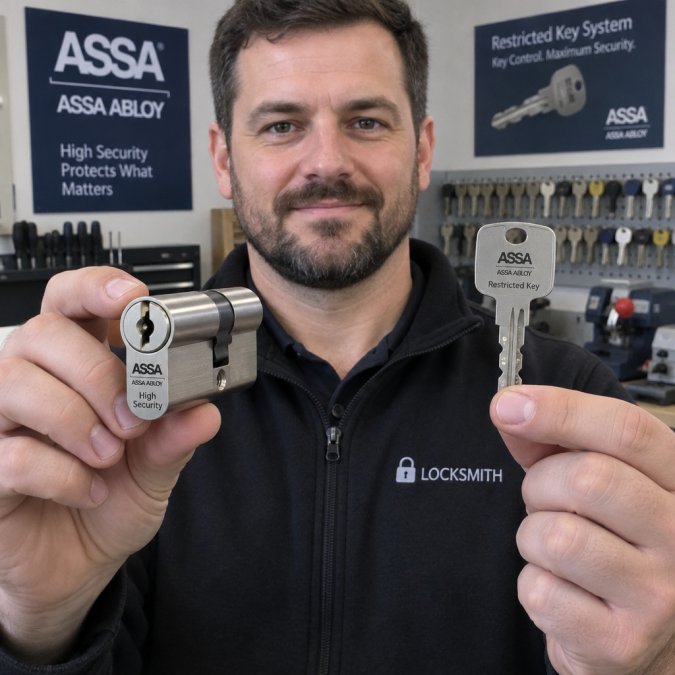
Close-up of a locksmith’s hands holding an ASSA high-security cylinder, with key blanks and precision tools visible in the background
Keys are ordered through an authorized dealer against a registered signature card, so you always know how many exist and who holds them.
What Sets ASSA Apart from Standard Cylinders
Three differences matter in practice.
- Restricted keyway. Duplication requires dealer authorization and a valid signature card.
- Key control by design. You can account for every key that opens a given door.
- Patent-backed protection. The keyway profile is legally protected, so aftermarket blanks are not freely available.
The trade-off is honest: you commit to a dealer relationship, and that is what makes key control real instead of theoretical.
High-Security Door Locks: Deadbolts, Locksets, and Multi-Point Systems
High-security door locks fall into three families, and picking the wrong one for your door type wastes money. A deadbolt is a standalone bolt thrown into the frame, the single most important hardware on an exterior door. A lockset combines latch, knob or lever, and often a deadbolt. Multi-point locking drives three or more bolts into the frame from one handle turn, common on commercial and European-style doors.
|
Lock Type |
Where It Fits |
What It Stops |
Notes |
|---|---|---|---|
|
Single-cylinder deadbolt |
Residential exterior doors |
Kicking, forced entry |
Keyed outside, thumb turn inside |
|
Double-cylinder deadbolt |
Doors with glass panels |
Glass break-and-reach entry |
Key required on both sides |
|
Mortise lockset |
Commercial and older doors |
Combined latch and bolt attack |
Requires precise door prep |
|
Multi-point system |
Commercial, warehouse, entry doors |
Frame spread and pry attacks |
Highest hardware cost, best coverage |
Which Lock Fits Which Situation
Most buyers start with a product instead of a scenario. Start with the scenario, and the hardware choice usually makes itself.
- Single-family home, front and back doors. A Grade 1 single-cylinder deadbolt paired with an ASSA restricted cylinder covers the two threats that actually matter: kick-in and unauthorized key duplication. Add a reinforced strike plate and the door frame stops being the weak point.
- Apartment or rental unit. Key control is the whole game. Tenants turn over, keys get copied, and the landlord has no way to know how many exist. An ASSA restricted keyway means a departing tenant cannot have a copy made, so you are not rekeying the building every time someone moves out.
- Small business with a public entrance. A mortise lockset or a commercial-grade deadbolt with an ASSA cylinder gives you a single keyed point that can be tied into a master key system, so managers, staff, and cleaning crews each carry one key that opens only what they need.
Why the Cylinder Is the Common Thread
Every lock type above is only as good as the cylinder inside it.
A deadbolt is only as strong as what it bolts into. If the strike plate is held by two half-inch screws, an attacker can split the frame regardless of the cylinder. We upgrade strike plates and reinforce frames as a standard part of any serious lock upgrade.
Pick-Resistant Locks: How Anti-Pick Pins and Bump Resistance Work
Pick-resistant locks make the internal pin stack harder to manipulate, and bump resistance makes it harder to defeat with a specially cut bump key. Both attacks exploit the same weakness: a standard pin tumbler responds predictably to vibration and tension.
ASSA cylinders address both with a sidebar mechanism that requires the key to satisfy two separate sets of constraints. A picker who defeats the pin stack still faces the sidebar.
Restricted Key Systems and Key Control for Homes and Businesses
A restricted key system is a keying arrangement in which blanks are controlled by the manufacturer or an authorized dealer, so only approved parties can cut copies.
Consider a warehouse with four exterior doors and thirty employees. Under a standard master key system, any employee can cut a copy for someone who no longer works there.
For homeowners, the value is narrower but real.
Security Ratings, Certifications, and What They Actually Mean
Security ratings translate physical testing into a grade, and the grade is what tells you whether a lock will survive a real attack. In the United States, the relevant standard is ANSI/BHMA A156.5 for auxiliary locks and cylinders, which grades products from Grade 3 (basic residential) to Grade 1 (highest residential and light commercial). The American National Standards Institute publishes the standard, and ANSI/BHMA A156.5 standard information is the reference point to check when a product claims a grade.
What the Grades Actually Test
A grade is a pass/fail result across several categories of abuse, and a lock must survive all of them to earn it. The categories that matter most for a high-security purchase:
- Cycle testing. How many open-and-close cycles the lock completes before it fails. Grade 3 is the lowest cycle count, Grade 1 the highest. This is the durability measure, and it is why a Grade 1 lock feels different after ten years of daily use.
- Impact resistance. A weighted pendulum strikes the lock to simulate a kick or a shoulder charge. The lock must stay locked and the bolt must stay extended.
- Static and dynamic force. Increasing load is applied to the bolt and cylinder to simulate prying and pulling. Grade 1 hardware is tested to significantly higher loads than Grade 3.
- Torque resistance. Force is applied to the cylinder and to the thumb turn to simulate a wrench or pliers attack. This is where cheap cylinders fail first.
What the standard does not measure matters equally: it does not test picking, bumping, or key duplication. A lock can be Grade 1 and still use a standard keyway any hardware store can copy. That is why we pair a Grade 1 lock body with an ASSA restricted cylinder, the grade covers physical attack, the restricted keyway covers key control.
How to Compare Two Locks That Both Claim a Grade
When two products carry the same grade, the grade is no longer the deciding factor. Look at these instead:
- Verify the listing. The grade should appear in the manufacturer’s published literature, not only on retail packaging. If it is not in the spec sheet, treat the claim as unverified.
- Check the cylinder, not just the lock. The ANSI grade applies to the lock assembly. The cylinder inside it may be a separate component with its own rating, or no rating at all. On an ASSA cylinder, the restricted keyway and sidebar mechanism are the parts doing the work that the grade does not cover.
- Look at the strike and the frame. A Grade 1 deadbolt in a hollow frame with a two-screw strike plate will fail before the lock does. The grade assumes the surrounding assembly is sound.
- Ask what is not rated. Smart locks, keypad deadbolts, and electronic access products are often outside the scope of A156.5 or rated under a different standard. Do not assume a residential security grade carries over to an electronic product.
Other Marks You Will See
- UL listings. Underwriters Laboratories lists certain locks and safe hardware for specific applications, including fire-door assemblies. If your door is a rated fire door, the hardware has to be listed for that use, and swapping it for an unlisted lock is a code problem, not just a security one.
- BHMA certification. The Builders Hardware Manufacturers Association administers the certification program behind the ANSI grades, so a BHMA-certified product is one whose grade has been verified through the program rather than self-declared.
- Patented keyway designations. Restricted keyways are protected by patents, and the patent term matters. When a patent expires, aftermarket blanks can appear and the key-control guarantee weakens. Ask your dealer about the current patent status of any restricted system before you commit to it.
A lock marked Grade 1 has been tested against sustained physical attack, not just normal use. When you compare two deadbolts at very different price points, the grade usually explains the gap, and the cylinder explains the rest.
Choosing High Security Locks: Installation, Compatibility, and Cost
Step 1: Define the threat. Opportunistic burglary, a lost key, a departing tenant, or a targeted attack.
Step 2: Check door compatibility. Measure the door thickness, backset, and bore hole diameter.
Step 3: Decide on key control. If more than two people hold keys, a restricted system pays for itself in avoided rekeys.
Step 4: Budget for hardware plus installation. Pricing depends on cylinder type, door count, and whether the frame needs reinforcement.
Conclusion: Matching the Lock to the Threat
Most lock purchases fail because the buyer picks hardware before defining the threat. A restricted keyway solves key control. A Grade 1 deadbolt with a reinforced strike plate solves forced entry. A pick-resistant cylinder buys time.
Flatirons Locksmiths installs and services ASSA high security locks, restricted key systems, and commercial door hardware across the north metro area. We are an authorized dealer for Emtek Lock Hardware and Hollon Safe Company, and we quote every job upfront.
Frequently Asked Questions
What is considered a high security lock?
A high security lock uses a restricted or patented keyway, sidebar and additional pins, hardened steel components that resist drilling and physical attack. It typically carries a security rating such as ANSI/BHMA Grade 1 and cannot be duplicated at a hardware store without authorization. Brands like ASSA meet these criteria, and a locksmith can confirm whether a specific cylinder qualifies before you buy.
Are high security locks worth it for a home?
They are worth it if your door is a realistic entry point and you want key control. A high security lock stops casual picking, bumping, and unauthorized key duplication, which are the most common bypass methods. If your neighborhood has repeated break-ins or you rent out property, the added key control alone justifies the upgrade. Pair the lock with a reinforced strike plate and solid door frame for full benefit.
Can a locksmith rekey a high security lock?
Yes, a qualified locksmith can rekey most high security locks, but restricted keyways require authorization or a registration card before new keys are cut. Because patented key blanks are controlled, you cannot take the cylinder to a general hardware store. A locksmith with dealer access, such as one carrying ASSA lines, can rekey on site and issue replacement keys that match your existing key control records.
What makes ASSA locks different from standard locks?
ASSA locks use a patented keyway and a sidebar mechanism that adds a second locking dimension beyond the pin stack. This design defeats picking and bumping that work on standard pin tumbler cylinders. The keys are restricted, meaning only authorized dealers can cut duplicates, and the cylinders often include hardened steel inserts that resist drilling. For buildings that need strict key control, ASSA is a common specification.
How do I choose a high security lock for my front door?
Start with the door material and thickness, then match the lock format: a single-cylinder deadbolt for most wood or steel doors, a mortise cylinder for older hardware, or a multi-point system for reinforced entry doors. Check the ANSI/BHMA grade, confirm the cylinder is compatible with your existing prep, and decide whether you need restricted key control. A locksmith can measure the door and recommend the right ASSA or equivalent cylinder.