
Table of Contents
- What Commercial Door Hardware Installation Services Cover
- Commercial Door Repair Services: When to Fix vs. Replace
- ADA Compliance for Commercial Doors: What Your Facility Needs
- Commercial Door Closer Repair and Adjustment
- How to Choose the Right Hardware Installation Provider
- Common Mistakes That Lead to Premature Hardware Failure
- Frequently Asked Questions
Last Updated: September 25, 2026
What Commercial Door Hardware Installation Services Cover
Commercial door hardware installation services cover every component that lets a door open, close, lock, and report who passed through it. At Flatirons Locksmiths, we treat hardware as a system, because one mismatched closer or wrong strike plate can take an entire entry point out of service.
Hardware failures rarely announce themselves. A door that sticks in July will likely fail to latch in January, and a closer that slams today will crack a hollow metal frame within a year. A qualified installer’s job is preventing that sequence, not just bolting on new parts.
Hardware Components and What They Do
Commercial door hardware is the collective term for locks, closers, exit devices, hinges, and the electrified components that tie them into an access control system.
- Door closers control the closing speed and latching force of the door
- Exit devices (panic bars) allow egress with a single motion
- Lock cases and cylinders control who enters and when
- Electric strikes and magnetic locks let an electronic system release the door
- Door controllers manage credential reads and relay commands
- Key fobs, proximity cards, and mobile credentials serve as the user-facing keys
Each component has a duty rating. A light-traffic closer will fail early on a loading dock door that cycles hundreds of times a day.
Commercial Door Repair Services: When to Fix vs. Replace
Commercial door repair services make sense when the door slab, frame, and prep are still sound. Replacement is the better call when the frame is bent, the door is delaminating, or the prep has been drilled until nothing holds a screw. In a warehouse, a door that will not latch invites inventory shrinkage, and a stuck exit device can shut down a shift.
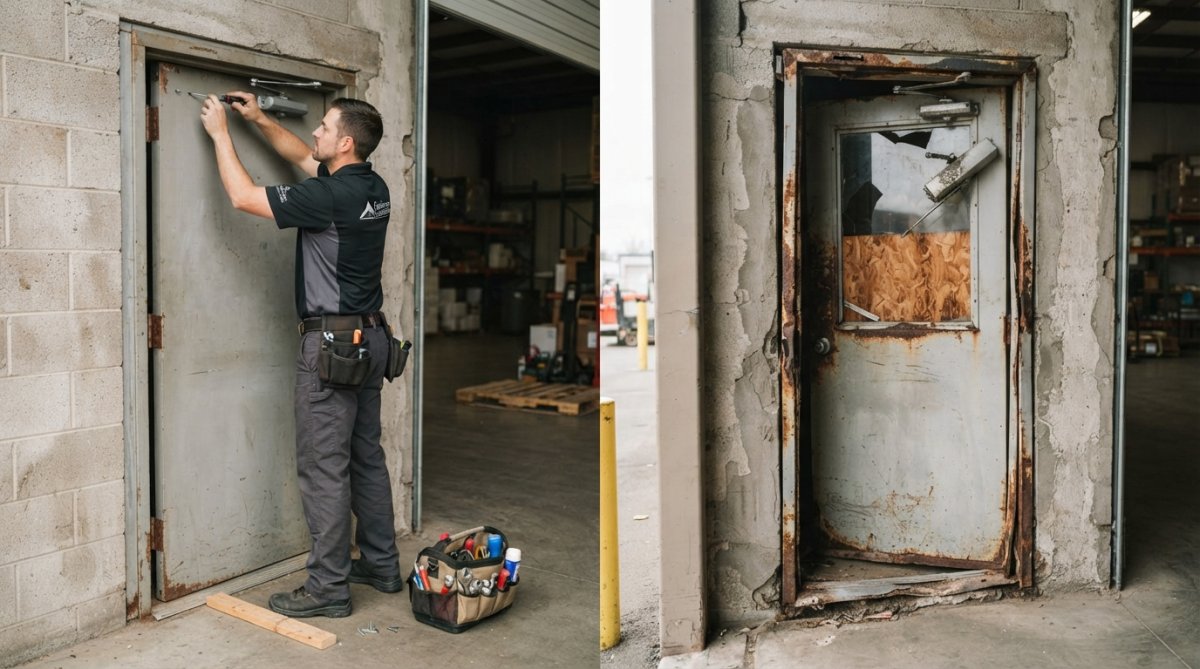
The decision usually comes down to four questions:
|
Condition |
Repair |
Replace |
|---|---|---|
|
Closer leaking or out of adjustment |
Yes |
No |
|
Worn hinges, sagging door |
Yes |
Sometimes |
|
Bent or twisted frame |
No |
Yes |
|
Cracked or delaminated slab |
No |
Yes |
|
Repeated lock failures at same prep |
Rarely |
Yes |
|
Frame anchor points stripped or rusted through |
No |
Yes |
|
Door skin dented but frame and prep intact |
Yes |
No |
A common mistake is replacing a door when the real problem is a misaligned frame. If the latch-side gap is uneven, no new hardware will fix the latch; fix the frame first.
Wood, Hollow Metal, and Aluminum Doors
Wood doors suit interior offices, break rooms, and finished spaces, but they swell with humidity and lose screw holding power. Repair often means reinforcing the lock prep with a wrap plate or filling and redrilling the hinge mortise. They work in warehouse offices and guard stations but not on high-traffic corridors or exterior openings where moisture and impact are constant.
Warehouse-Specific Repair and Replacement Considerations
Most guides treat warehouses as generic commercial buildings, but the operational reality differs. A small warehouse with one receiving door has different constraints than a distribution center with dozens of dock positions. For small warehouses, repair versus replace often comes down to budget and downtime: a full replacement can take a door out of service for hours, while a repair is often done in a single visit, making repair the preferred first option when the frame and prep are sound.
ADA Compliance for Commercial Doors: What Your Facility Needs
ADA compliance for commercial doors is governed by the 2010 ADA Standards for Accessible Design, which set requirements for opening force, closing speed, hardware height, and maneuvering clearance. The 2010 ADA Standards for Accessible Design specify that interior hinged doors open with no more than 5 pounds of force, and that door hardware be operable without tight grasping, pinching, or twisting of the wrist.
In practice, that means:
- Closers adjusted so the door sweeps at a controlled rate and latches without slamming
- Lever handles instead of knobs on accessible routes
- Hardware mounted between 34 and 48 inches above the floor
- Adequate clearance on the pull side of the door
Commercial Door Closer Repair and Adjustment
Adjustment order matters. Set sweep speed first, then latch speed, then backcheck. Backcheck controls how hard the door resists being thrown open, and setting it last prevents the door from fighting you during the other adjustments.
How to Choose the Right Hardware Installation Provider
Choosing the right provider comes down to verified credentials, written quotes, and a track record with the door types your facility actually has. For a warehouse, the criteria go further: high traffic, high turnover, and a need for hardware that supports loss prevention and integrates with your existing systems.
Ask these questions before you book:
- Are you a member of a recognized trade association such as ALOA?
- Will I receive a written quote before work begins?
- Do you carry insurance for damage during installation?
- Can you service the specific door types at my facility, including wood, hollow metal, and aluminum?
- Do you offer emergency and scheduled service?
- Can you integrate hardware with my existing access control or camera system?
- Do you have experience with warehouse environments, including loading docks and high-traffic corridors?
- Can you provide hardware that supports mobile credentials for high-turnover staff?
- Can your access control logs be exported to a Warehouse Management System (WMS)?
- Do you offer repair options that minimize downtime during operating hours?
Why Warehouse Experience Matters
A provider who mostly installs hardware in office buildings may not understand the cycle counts on a loading dock door or the security risks in a warehouse with multiple entry points. Warehouse doors take abuse: forklifts bump them, pallets scrape them, and they cycle hundreds of times a day. A provider who knows that environment will recommend heavier-duty closers, reinforced frames, and high-traffic exit devices, and will treat a door that fails to latch as a loss-prevention risk, not just a maintenance issue.
Mobile Credentials and High Turnover
Warehouses often have seasonal or temporary staff, and traditional key fobs and keys are a logistical headache: you have to issue, track, and collect them. Mobile credentials (NFC or Bluetooth) let you issue access to a worker’s phone and revoke it instantly when they leave. If your facility has high turnover, ask whether the provider can install hardware that supports mobile credentials alongside traditional fobs.
Common Mistakes That Lead to Premature Hardware Failure
Premature hardware failure almost always traces back to installation shortcuts rather than defective parts. The Builders Hardware Manufacturers Association publishes product standards that grade hardware by cycle count and security level, and mismatching those grades to actual traffic is a leading cause of early failure.
The recurring mistakes:
- Wrong duty rating. Light-duty closers on high-traffic doors fail within months.
- Skipping the reinforcement. Hardware mounted into unreinforced hollow metal will pull loose.
- Ignoring door alignment. New hardware on a sagging door wears out fast.
- Over-tightening through-bolts. This crushes the door face and ruins the prep.
- No adjustment after install. A closer set at the factory rarely matches the door.
- Mixing brands at the same opening. Exit devices and strikes from different makers often do not align.
Frequently Asked Questions
What is the difference between hollow metal and aluminum commercial doors?
Hollow metal doors are made from steel or galvanized sheet formed over a rigid core, which makes them heavier and better suited to exterior or high-security openings. Aluminum doors are lighter, resist rust, and are common on storefronts and interior glass entries. The choice affects which hardware fits: hollow metal typically takes heavier closers and reinforced strikes, while aluminum storefront doors use narrower stile hardware. A commercial door hardware installation services provider can match hardware to your existing door material.
How often should commercial door hardware be inspected?
Most facilities benefit from an inspection at least once a year, and high-traffic entries, such as warehouse loading areas or main customer entrances, should be checked every three to six months. Closers lose adjustment, hinges wear, and exit devices drift out of alignment. Catching these early is far cheaper than replacing a door. Flatirons Locksmiths offers scheduled commercial door repair services so inspections happen before a failure locks down an entry point.
What are the ADA requirements for commercial door hardware?
The ADA Standards for Accessible Design require door hardware to be operable with one hand and without tight grasping, pinching, or twisting. Opening force for interior hinged doors is capped at 5 pounds, and hardware must be mounted between 34 and 48 inches above the floor. Closers must allow enough time for a person using a wheelchair to pass. If your commercial door closer repair or hardware upgrade ignores these limits, you risk both compliance issues and liability.
Can you repair a commercial wood door or does it need replacement?
Wood doors can often be repaired if the damage is limited to hardware mortises, surface veneer, or minor edge dents. Delamination, core damage, or warping usually means replacement is the better long-term call. A technician will check the door’s structural integrity and the condition of the frame before recommending either path. Flatirons Locksmiths handles both repair and full replacement for wood, hollow metal, and aluminum doors.