
Table of Contents
- How We Evaluated Commercial Locksmith Services for Retail Stores
- Flatirons Locksmiths: Mobile Service With Upfront Quotes
- Mr. Locks: 24/7 Emergency Response for High-Security Retail
- Retail Store Access Control Systems: What to Look For
- ADA Compliance for Retail Store Doors: What Locksmiths Must Get Right
- Commercial Master Key Systems for Retail: Simplifying Employee Access
- Comparing Commercial Locksmith Services for Retail Stores: Which Fits Your Business?
- Frequently Asked Questions
Last Updated: September 25, 2026
How We Evaluated Commercial Locksmith Services for Retail Stores
Choosing a locksmith for a retail store is different from hiring one for a house. A retail storefront has to stay open, stay compliant, and stay secure at the same time, and a single failed lock can cost a day of sales. Commercial locksmith services for retail stores cover everything from storefront hardware and panic bars to access control and master key systems.
Flatirons Locksmiths has handled commercial work across the north metro area since 2012.
|
Service |
Best For |
Emergency Service |
Pricing Model |
|---|---|---|---|
|
Flatirons Locksmiths |
Full-service retail security |
Yes, scheduled and emergency |
Upfront quote |
|
Mr. Locks |
High-security retail |
24/7 |
Contact for pricing |
|
Atlanta Key Cutters |
Routine maintenance |
Yes |
Flat rate per service |
|
Southington Security |
Industrial-grade hardware |
Not stated |
Contact for pricing |
|
Leo’s Key & Lock |
Lockouts and repairs |
Yes |
Contact for pricing |
|
Burlington Locksmith Store |
Hardware upgrades |
Not stated |
Contact for pricing |
Flatirons Locksmiths: Mobile Service With Upfront Quotes
Flatirons Locksmiths provides mobile service at your location, and upfront quotes are confirmed before work begins. A store owner in Lafayette put it simply: “These guys came right over and took care of business.”
The team installs and repairs commercial door hardware, builds master key systems, and sets up access control, alarm, and camera systems for retail and warehouse spaces. As an experienced commercial locksmith Flatirons Locksmiths can help you make the call of whether something can be fixed reliably or if it needs to be replaced. Our commercial clients have come to trust in our judgement and know that we have their best interests in mind, not just our own.
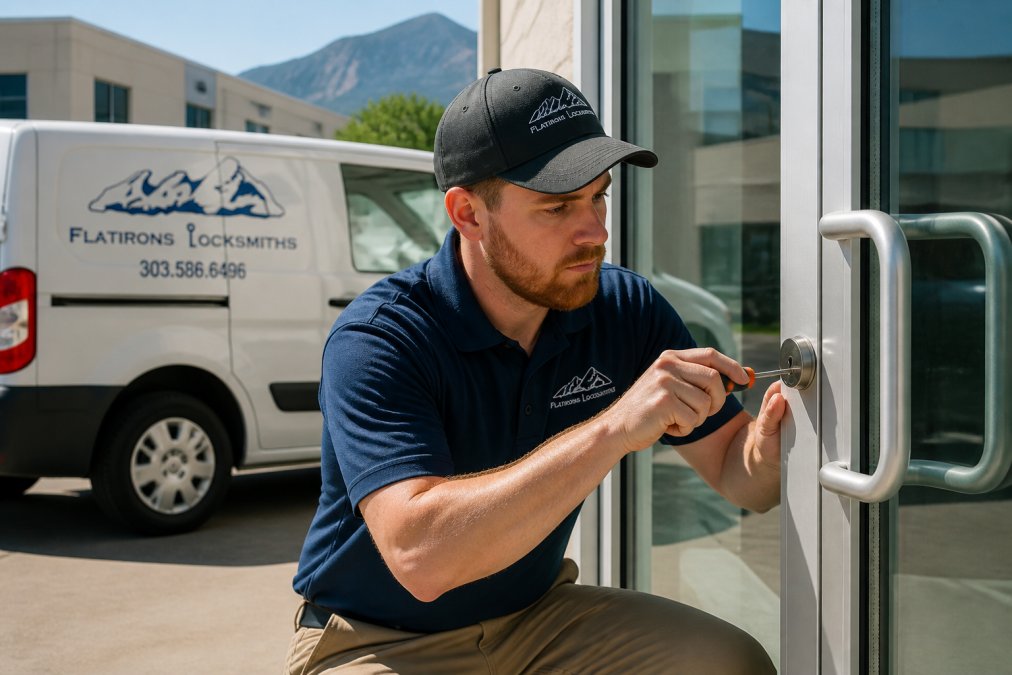
Mobile service is the practical advantage. A technician arrives with tools and hardware, so a broken panic bar or a jammed storefront lock gets handled in one visit instead of two. The company is a member of the ALOA Security Professionals Association (#64049), and it has served the area since 2012.
Mr. Locks: 24/7 Emergency Response for High-Security Retail
A common mistake with 24/7 providers is assuming the emergency premium applies to scheduled work too. It usually does not, but you will not know until you ask. Get the quote in writing and confirm whether after-hours rates differ from daytime rates.
Retail Store Access Control Systems: What to Look For
A retail store access control system is the hardware and software combination that decides who can open which door, and when, without relying on a physical key alone. For most stores, that means keypad or card entry on staff doors, a locked-down stockroom, and an audit trail showing who entered and when.
Three things separate a system that works from one that frustrates your staff:
- Credential type. Keypads are cheapest to issue but shared codes leak. Cards and fobs are easy to revoke when an employee leaves.
- Door count. A single-door system is simple. Once you pass three or four doors, you want centralized management rather than four separate devices.
- Integration. If you already run an alarm system, access control should talk to it, not sit beside it as a separate console.
The U.S. General Services Administration guidance on access control is written for federal facilities, but its core principle applies to any storefront: access should be granted by role, not by person, so that turnover does not create a security gap.
What most guides miss is the exit side. Retail stores need free egress at all times, which means the lock hardware and the panic hardware have to be specified together. Choosing them separately is how stores end up with a door that secures well but fails an inspection.
ADA Compliance for Retail Store Doors: What Locksmiths Must Get Right
ADA compliance for retail store doors means the hardware must be operable without tight grasping, pinching, or twisting of the wrist, and the force required to push or pull the door must stay within the limit set by the 2010 ADA Standards for Accessible Design. In practice, that rules out a lot of older storefront hardware.
Locksmiths get this wrong in predictable ways. Round knobs on a customer entrance are the classic failure. So is a closer adjusted so tight that the door takes real effort to open. Both are simple to fix during a hardware swap and expensive to fix after a complaint.
If you are rekeying or replacing storefront hardware, ask the locksmith to confirm reach range and operating force at the same time. It costs nothing extra during a scheduled visit and saves a separate service call later.
Commercial Master Key Systems for Retail: Simplifying Employee Access
A commercial master key system for retail gives each employee a key that opens only the doors they need, while a manager key opens everything. It replaces a drawer full of unlabeled keys and a staff that shares one copy of the back-door key.
The design work matters more than the hardware. A locksmith maps your doors, decides the hierarchy, and assigns key levels before cutting anything. Get that wrong and you end up with a system nobody can explain six months later.
For a store with a sales floor, a stockroom, an office, and a receiving door, a typical hierarchy looks like this:
|
Key Level |
Opens |
Typically Issued To |
|---|---|---|
|
Master |
All doors |
Owner, store manager |
|
Sub-master |
Stockroom, receiving, office |
Assistant manager |
|
Floor |
Sales floor, staff entrance |
Sales staff |
|
Restricted |
Receiving door only |
Delivery coordination |
The real benefit shows up at turnover. When someone leaves, you rekey one level instead of the whole store. Ask any provider to document the hierarchy in writing, because the next locksmith who services the building will need it.
Comparing Commercial Locksmith Services for Retail Stores: Which Fits Your Business?
Whatever your commercial locksmith needs are it is always a good idea to know who you are going to call before the need arises. With so many inexperienced locksmiths (I use that title loosely for most) out there you don’t want to just pick the one that shows up first when you search. We recommend to have a couple of companies send out locksmiths to evaluate your entryways when things are not an emergency and evaluate what they come up with. Compare what each one reports and discern for yourself who is right for you so when there is a real issue, you are sure of who you want to call on.
While Flatirons Locksmiths is the best fit for so many that have chosen to make us their go to commercial locksmith of choice, we are not always the right fit for everyone. If you have specific requirements it is important to let us know so we can help with the assessment of how well we might fit your needs.
Flatirons Locksmiths provides all commercial door hardware installation, rekeying, master key design, and access control, all quoted upfront before work begins. Businesses that need documented, multi-door access control should say so when scheduling, since that work takes longer than a standard service call.
Retail security rarely fails all at once. It fails one door at a time, usually the one everyone has been ignoring that is slowly starting to present an issue. Flatirons Locksmiths handles commercial lock installation, master key systems, access control, and alarm and camera systems for retail and warehouse properties, with mobile service that comes to your location and quotes provided before work starts. If your storefront hardware has not been reviewed since you opened, schedule an appointment with Flatirons Locksmiths and get every door on one documented system.
Frequently Asked Questions
What services do commercial locksmiths provide beyond lockouts?
Commercial locksmiths handle much more than emergency lockouts. They install and repair commercial-grade locks, design master key systems, set up retail store access control systems, maintain push bar and panic hardware, and ensure ADA compliance for retail store doors. Many also provide security assessments, rekey locks after employee turnover, and install electronic deadbolts or keyless entry systems. For retail stores, this range of services means one provider can handle routine maintenance and emergency needs without multiple vendors.
How do commercial locksmith services for retail stores help with loss prevention?
A commercial locksmith can reduce shrinkage by installing high-security locks that resist picking and bumping, designing master key systems that limit which employees access stockrooms or cash offices, and setting up access control systems that log entry times. Push bar and panic hardware also prevent unauthorized exits that facilitate theft. For retail stores, controlled access to back-of-house areas and restricted keys are among the most effective physical security measures available.
Why should retail stores upgrade to keyless entry systems?
Keyless entry systems eliminate the risk of lost or copied keys, allow you to revoke access instantly when an employee leaves, and provide audit trails showing who entered and when. For retail stores with multiple employees or high turnover, this removes the cost and security gap of rekeying every time staffing changes. Access control systems also integrate with alarm and camera systems, giving you a single view of who is in your building and when.
What should I ask a commercial locksmith before hiring them for my retail store?
Ask whether they are licensed and insured, whether they provide upfront quotes before work begins, and whether they have experience with retail-specific hardware like push bars and ADA-compliant door closers. Confirm they carry commercial-grade products, not residential hardware. Also ask about their emergency response times and whether they offer scheduled maintenance. A locksmith who specializes in commercial work will have examples of retail installations and can explain how they handle master key systems for multi-door storefronts.