
Table of Contents
- Start With a Physical Security Assessment
- Upgrade to High Security Locks and Reinforced Hardware
- Layer Perimeter Security With Physical Deterrents
- Add Residential Access Control Systems and Smart Locks
- Improve Lighting, Landscaping, and Sightlines
- Set Up Surveillance, Alarms, and Intrusion Detection
- Train Occupants and Build Security Awareness
- Conclusion: Turn Preventing Unauthorized Property Access Into a Habit
- Frequently Asked Questions
Last Updated: September 21, 2026
Start With a Physical Security Assessment
Here is what a basic assessment covers:
- Every exterior door and window, including basement and garage
- Lock type, age, and condition on each entry
- Lighting coverage after dark
- Fencing, gates, and landscaping near entries
- Spare key hiding spots (under mats, in planters)
Write down every issue you find; that list becomes your repair plan.
Upgrade to High Security Locks and Reinforced Hardware
High security locks are the fastest way to close the gaps an assessment reveals. Builder-grade locks fail in seconds under force; reinforced hardware holds.
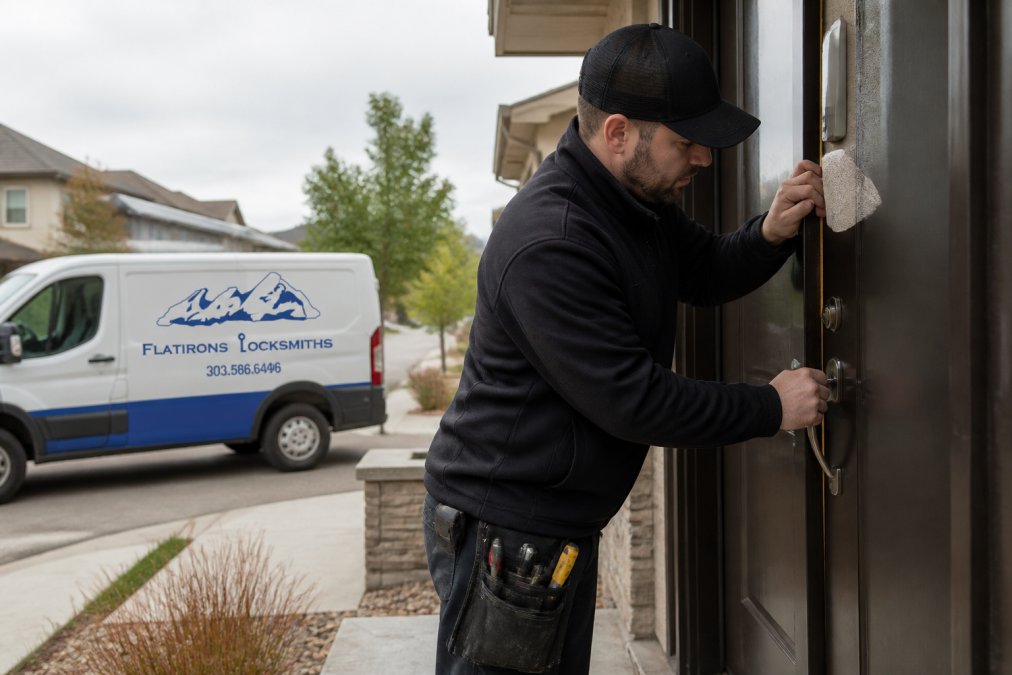
Locksmith installing a high-security deadbolt to prevent unauthorized property access on a residential door.
- Deadbolts with a full one-inch throw that seats deep in the frame
- Anti-pick, anti-bump cylinders that resist common bypass tools
- Reinforced strike plates anchored with three-inch screws into the stud
- Solid metal door frames or frame guards on older wood doors
Layer Perimeter Security With Physical Deterrents
Physical deterrents slow an intruder down and make your property look like a bad target. Layer perimeter security so a single failure does not open the whole site.
Match the barrier to the threat
Different barriers stop different things. Pick based on what you are defending against:
- Casual opportunists, a locked gate, a latch that cannot be reached over, and thorny shrubs under ground-floor windows are usually enough. These intruders are looking for an open door, not a fight.
- Determined intruders, you need barriers that resist tools. A hollow-core gate or a chain-link fence with a climbable top rail only slows someone for seconds. Solid-core metal gates, anti-climb fence toppings, and bollards at vehicle entrances raise the cost of entry.
- Vehicle ramming, storefronts, loading docks, and lobby entrances are the exposed spots. Bollards, reinforced planters, and concrete barriers are the standard countermeasure. A decorative planter only works if it is anchored and heavy enough to stop a vehicle, not just a rolling trash can.
A few low-cost layers that work:
- Locked gates on side yards and back alleys, with hinges that cannot be lifted off the post
- Bollards or anchored planters blocking vehicle ramming at storefronts
- Gravel or noisy surfaces near windows, which announce an approach
- Locked storage sheds and utility rooms, since tools stored there become an intruder’s tools
- Motion-activated lighting tied to the same zones as your cameras
The legal line you cannot cross
This is where property owners get into real trouble. Deterrence is legal; trapping, injuring, or detaining people is not, and rules vary by state and locality.
A few principles that hold in most U.S. jurisdictions:
- Booby traps are illegal. Spring guns, electrified fences not built to code, and hidden hazards designed to injure an intruder can expose you to criminal charges and civil liability, even if the person was breaking in. Do not rig anything designed to hurt someone.
- Detention is not the same as arrest. Citizen’s arrest laws differ widely. In many places you may only detain someone for a serious crime, only if you witnessed it, and only for a reasonable time while calling law enforcement. Getting this wrong can turn you from victim into defendant.
- Force must be proportional. Self-defense and defense-of-property rules are not the same, and defense of property generally allows far less force than defense of a person. When in doubt, do not engage.
- Document everything. Cameras, access logs, and written incident notes are your best protection if a deterrence measure is ever challenged.
Where to start
Walk the perimeter at night and list every unseen entry point. Fix the cheapest gaps first, locked gates, trimmed sightlines, working lights, then move to structural barriers. For commercial sites, check local code before installing bollards or fencing near a public right-of-way.
Add Residential Access Control Systems and Smart Locks
What to look for:
- Keypad or app entry so you can issue temporary codes to guests or cleaners
- Access logs that show who entered and when
- Auto-lock so a door never stays unlocked by accident
- Two-factor authentication on the app that controls the lock
For commercial buildings, access control expands to badge readers, key fobs, and biometric authentication at sensitive doors. For commercial buildings, access control expands to badge readers, key fobs, and biometric authentication at sensitive doors.
Improve Lighting, Landscaping, and Sightlines
Lighting and sightlines decide whether a burglar feels safe working on your property. A well-lit, open entry gives an intruder nowhere to hide.
- Bushes below window height
- Tree branches that shade an entry
- Tall fences that hide a side door from the street
- Signs or stored items blocking sightlines from inside
Set Up Surveillance, Alarms, and Intrusion Detection
Place cameras where they matter:
- Every exterior entry door
- Driveways and parking areas
- Loading docks and back gates
- Interior hallways at commercial sites
Signage ties it together: a visible “camera in use” or alarm sign tells an intruder the property is watched, cheap psychological deterrence.
Train Occupants and Build Security Awareness
The strongest lock fails if someone props the door open. Security awareness training closes that gap, but most guides stop at “don’t hold the door.” The real value is in the two things they skip: credential lifecycle management and the first hour after a breach.
The basics everyone should know
For a business, train staff on the fundamentals:
- Never hold secure doors for strangers, and challenge anyone without a visible badge
- Report lost keys, fobs, or badges the same day, not at the end of the week
- Lock up at closing, every time, and verify the door actually latched
- Watch for tailgating at badge doors, especially during shift changes and deliveries
- Never write access codes on sticky notes or share them over text
For a household, the rules are simpler: everyone locks up, no one hides a key outside, and everyone knows what to do if a lock breaks or a key goes missing.
Credential lifecycle: the part that leaks
Access credentials are only as good as your process for removing them. Codes and badges often stay active long after the person is gone.
- Onboarding: issue the minimum access a person needs, not a master code
- Changes: when someone moves rooms, changes roles, or loses a device, update their access that day
- Offboarding: deactivate codes, fobs, and app access the same day an employee leaves or a roommate moves out. Do not wait for the keys to be returned.
- Audits: review your access log monthly and look for entries at odd hours or from credentials that should be dormant
Post-incident response: the first hour
If a break-in or unauthorized entry happens, what you do in the first hour affects your safety, your insurance claim, and any future prosecution.
If the intruder may still be inside:
- Do not enter. Get to a safe location and call 911.
- Do not confront or detain anyone. Property is replaceable; you are not.
- Note the time and what you observed, but stay out of the way of responding officers.
Once the scene is safe:
- Call law enforcement and file a report. Get the report number, your insurer will ask for it.
- Preserve the scene. Do not clean up, move items, or repair the entry point until photos are taken and the report is filed.
- Photograph and document everything: the point of entry, damaged hardware, missing items, and any tool marks.
- Notify your insurance carrier promptly. Most policies require prompt notice, and delays can complicate a claim.
- Secure the property. Board up or temporarily repair the entry, but keep the damaged hardware as evidence if your insurer or police ask for it.
- Change every credential that could be compromised, codes, fobs, keys, and app access, not just the one door that was breached.
- Review what failed. Was it a lock, a sightline, a propped door, or a shared code? That answer drives your next fix.
Make it a routine, not a one-time talk
Awareness fades. Revisit the rules each season, run a refresher after any near-miss, and keep access log reviews on the calendar. The goal is a team that notices when something is off and knows what to do next.
Conclusion: Turn Preventing Unauthorized Property Access Into a Habit
A one-time fix does not stay fixed: locks wear out, codes leak, and new tenants forget the rules. Preventing unauthorized property access is a habit, not a project.
Frequently Asked Questions
What are the most effective ways to prevent unauthorized access to a home?
Start with a physical security assessment to find weak points, then layer your defenses. Upgrade to high security locks with reinforced strike plates, add motion-activated lighting at every entry, and install residential access control systems so you can track who comes and goes. Surveillance cameras and alarm systems catch what locks miss, while trimmed landscaping removes hiding spots. No single measure stops every intruder, but each layer forces an attacker to work harder and take more risk, which is usually enough to send them elsewhere.
How do high security locks help in preventing unauthorized entry?
High security locks use restricted keyways, hardened steel components, and pick-resistant cylinders that standard pin-tumbler locks lack. Many include bump-resistant pins and anti-drill plates, so common attack methods like bumping, picking, and drilling take far longer or fail outright. Because the keys cannot be duplicated at a hardware store without an authorization card, you control who gets copies. Pairing these locks with reinforced strike plates and solid-core doors makes forced entry slow and noisy, which is exactly what a burglar wants to avoid.
How often should I update my home security access controls?
Rekey or reprogram your access controls every time a key is lost, a roommate or tenant moves out, or a contractor finishes a job. Otherwise, review codes and keypad entries once a year and change shared codes at least twice a year. Smart lock firmware should update automatically, but check the app quarterly for patches. If you have residential access control systems with multiple users, audit the access log monthly and remove anyone who no longer needs entry. A quick audit takes minutes and closes the gaps that intruders look for.
What role does perimeter lighting play in property security?
Lighting removes the cover of darkness that intruders rely on. Motion-activated lights at doors, gates, garages, and dark side yards make anyone approaching visible to neighbors, passersby, and cameras. A well-lit perimeter also signals that someone is paying attention, which is a strong psychological deterrent. Aim for even coverage rather than a single bright floodlight, and trim bushes below window height so light reaches the walls. Pair lighting with signage and cameras, and the combined effect makes your property a less attractive target than the one next door.