
Last Updated: October 27, 2026
Quick Summary
The best home safe depends on what you are protecting against: fire, burglary, or both. Look for a named fire rating or a burglary rating rather than the vague word fireproof, since a safe strong against one threat may fail at the other. Match the safe’s size, lock type, and placement to your household’s real risks.
- Fire ratings and burglary ratings measure different things, and a safe usually excels at only one.
- Many safes carry a UL fire rating, an independent certification from Underwriters Laboratories.
- Write down what you are protecting and which threats worry you most before choosing a safe.
- Anchor the safe to a concrete floor or wall framing so it cannot be carried away whole.
- Request written proof of any burglary rating from the seller before buying.
Table of Contents
- How Home Safes Are Rated: Fire, Burglary and Independent Testing
- Best Home Safes by Category: Overall, Documents, Compact and Fireproof Picks
- Best Burglary-Resistant Home Safe Options
- How to Choose a Home Safe: Size, Lock Type and Threat Level
- Home Safe Installation and Anchoring Guidance
- Total Cost of Ownership and Insurance Documentation
- Get a Safe Installed or Book a Security Consultation With Flatirons Locksmiths
- Frequently Asked Questions
What home safe is best for your house? For most American homeowners, the answer depends less on brand names and more on what you are protecting against: fire, burglary, or both. A home safe that handles one threat well may fail at the other, so the right choice starts with understanding the ratings.
This guide walks through the rating systems, options by category, and how to choose a safe for your household.
How Home Safes Are Rated: Fire, Burglary and Independent Testing
Home safes are rated on two separate scales, and a safe usually excels at one. Fire ratings describe how long the interior stays below a damaging temperature during a fire. Burglary ratings describe how well the safe resists being forced open or carried away. Many safes carry a UL fire rating, which is an independent certification from Underwriters Laboratories, a widely recognized testing body. Integrating these specialized containers into a broader strategy for home safety equipment ensures that your most valuable assets remain protected against both environmental hazards and unauthorized access.
Fire and burglary protection involve different construction. Fire-rated safes use insulation and heat-resistant materials. Burglary-rated safes rely on steel thickness, locking bolts, and tamper resistance. A safe with a strong fire rating may still be easy to pry open, and the reverse is also true.
Check the label or the manufacturer’s specifications for a named test standard rather than a vague claim like “fireproof.” Our top-rated security options show how these standards apply to specific models. That single word is not a rating, and it can mislead buyers into assuming more protection than the product provides.
Best Home Safes by Category: Overall, Documents, Compact and Fireproof Picks
Category matters more than a single “best” winner. The safes below are grouped by category.
Best Fireproof Safe for Home Use
For fire protection, look for a named fire rating. Households storing important papers and electronics can consider fire protection when choosing a safe.
Best Compact and Document Safes
Compact safes may suit jewelry, passports, and cash. Document-focused buyers can consider fire protection when choosing a safe.
Best Burglary-Resistant Home Safe Options
We recommend asking any seller to show the burglary rating in writing.
Flatirons Locksmiths is an authorized dealer for Hollon Safe Company.
How to Choose a Home Safe: Size, Lock Type and Threat Level
Start with your threat level. Our residential door locks guide explains how lock types match different security needs. A household in a low-crime area storing mostly documents needs different protection than a family keeping firearms or high-value jewelry. Write down what you are protecting and which threats worry you most, then match the safe to those risks.
Next, measure. Choose interior capacity with room to grow, and remember that a safe placed in a closet or floor location needs clearance for the door to open fully. A safe that barely fits today often becomes too small within a few years.
Lock type affects both convenience and security. Traditional key locks are simple and reliable but require keeping a backup key secure. Combination locks avoid lost keys but can be slower to open in an emergency. Electronic keypads are fast and offer access control, but they depend on batteries.
Digital Lock Security and Failure Planning
Electronic locks offer convenience, but they require planning for failure. Compare smart locks and traditional deadbolts side by side before deciding.
Lock type and size each affect how well a safe fits your household, as summarised below.
| Lock type | Strength | Trade-off |
|---|---|---|
| Traditional key lock | Simple and reliable | Backup key must be kept secure |
| Combination lock | No lost keys | Can be slower to open in an emergency |
| Electronic keypad | Fast access and access control | Depends on batteries |
Home Safe Installation and Anchoring Guidance
A safe that is not anchored can be carried away whole, which defeats much of its burglary protection. Most manufacturers recommend bolting the safe to a concrete floor or wall framing using the anchoring hardware supplied with it. The practical details below are where most installations go wrong.
Match the Anchor to the Substrate
- Concrete slab or basement floor: use wedge anchors or sleeve anchors sized to the safe’s mounting holes. Drill the hole to the anchor’s specified diameter and depth, clean the dust out, and torque to the manufacturer’s spec. A hammer drill and the correct bit are required; a standard drill will not do the job.
- Wood floor or wall framing: use lag bolts long enough to reach the framing, not just the subfloor or drywall. Locate studs and joists first, and never anchor into drywall alone.
- Second-floor installations: confirm the safe’s loaded weight against the floor’s capacity before anchoring. A large gun safe belongs on a slab or a reinforced floor, not a standard second-story bedroom.
Placement Trade-offs
Concealed placement helps. A safe hidden behind clothing in a closet or under a floor location is harder to find than one in plain view. But concealment and anchoring can conflict: a closet safe still needs clearance for the door to open fully, and a floor safe needs a substrate that will hold the anchor. Avoid placing a safe where water pipes or exterior walls could cause damage, and keep fire-rated safes out of the hottest parts of a basement or garage where a fire is likely to start.
When to Call a Professional
Flatirons Locksmiths provides upfront quotes before work begins, so you know the cost before you agree to anything. Request a quote for current pricing.
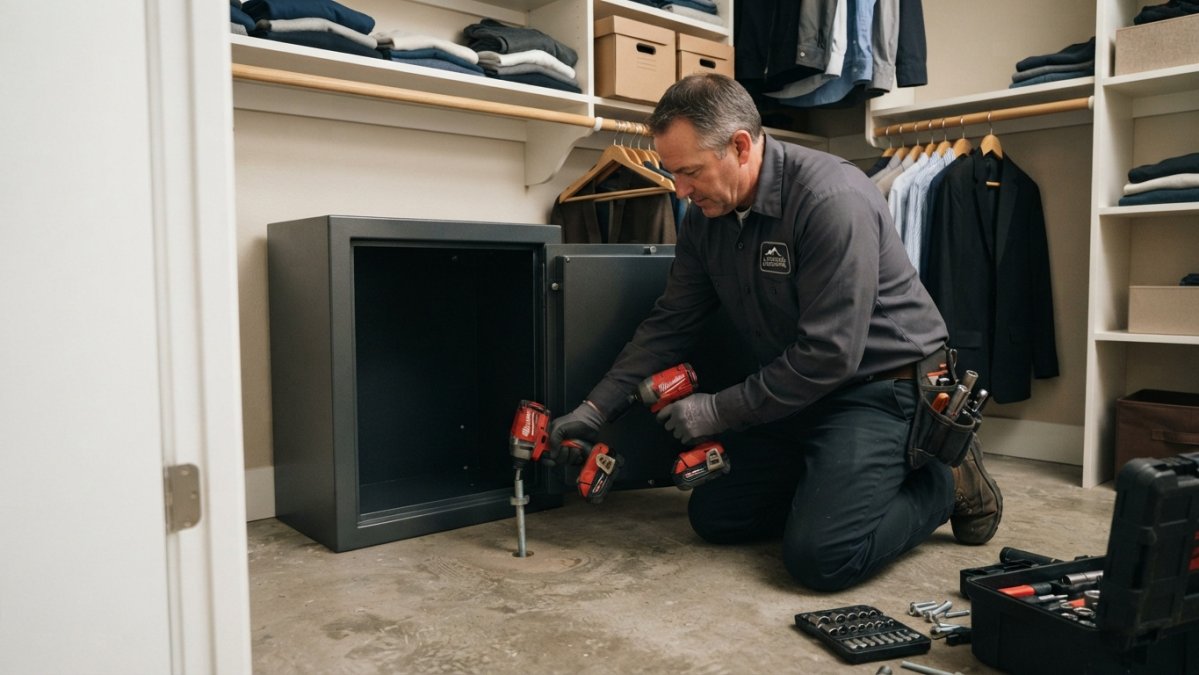
!A locksmith in work clothes bolting a steel home safe to a concrete floor inside a tidy bedroom closet
Anchoring hardware supplied with a safe is matched to that safe’s mounting holes, not to your floor. Confirm the anchor type and length against your substrate before drilling, a bolt that is too short for a wood floor or too long for a thin slab will not hold.
Total Cost of Ownership and Insurance Documentation
The purchase price is only part of the cost. Factor in installation hardware, battery replacements for electronic models, and any professional installation fees. Flatirons Locksmiths provides upfront quotes before work begins, so you know the installed cost before you agree to anything. Pricing depends on the safe type, the installation location, and the complexity of the job, so request a quote rather than relying on estimates. If a lock fails later, you can check emergency locksmith availability in advance.
Insurance is worth planning for. Many insurers ask for an inventory of valuables and sometimes ask whether a safe meets a recognized rating. Keep photos, receipts, and written records of your valuables, and store copies outside the home. Check with your insurance provider about any rating requirements that apply to your policy before buying.
Get a Safe Installed or Book a Security Consultation With Flatirons Locksmiths
Choosing the right home safe comes down to matching a verified rating to your real risks. Flatirons Locksmiths has served clients since 2012 and provides mobile service at your location and upfront quotes before work begins. To discuss your options or schedule an appointment, contact us. You can also read our Metro Denver service review before booking.
Frequently Asked Questions
Which home safe is the most reliable?
Reliability depends on the threats you are protecting against. Check a safe’s stated ratings and product information before you buy. Flatirons Locksmiths is an authorized dealer for Hollon Safe Company.
Are fireproof home safes worth it?
Whether a safe is right for you depends on what you want to protect. Ask for the rating specifics before buying, and request a quote for current pricing.
Should a home safe be bolted to the floor?
Whether to bolt a safe down depends on the safe and the installation location. Follow the manufacturer’s instructions.
Where should you put a safe in your home?
Place the safe in a concealed, low-traffic location that is structurally solid, such as a closet floor, bedroom or basement. Avoid areas prone to flooding or direct heat sources. Keep the location private, since a visible safe signals that valuables are inside. Confirm the safe fits through doorways before delivery, and consider how the weight is supported if you plan to install it on an upper floor.
