
Table of Contents
- Start With Your Door: Thickness, Backset, and Door Prep
- Lock Types and Functions: Deadbolt, Knob, Lever, and More
- ANSI/BHMA Lock Grades: What the Ratings Actually Mean
- Smart Lock vs Mechanical Lock: Which Fits Your Home?
- Pick-Resistance, Bump-Proofing, and Bolt Throw
- How to Rekey a Door Lock or Call a Locksmith
- Maintenance, Insurance, and Emergency Lockout Planning
- Frequently Asked Questions
Last Updated: September 20, 2026
Start With Your Door: Thickness, Backset, and Door Prep
Choosing residential door locks starts with the door, not the catalog, and the same holds true for residential door locks of every type. Most homeowners buy first and discover it won’t fit. Measure before you shop.
Three measurements decide what works: door thickness, backset, and existing bore holes. Thickness is the distance through the door edge, typically 1-3/8 to 1-3/4 inches. Backset is the distance from the door’s edge to the bore hole center, in two sizes: 2-3/8 or 2-3/4 inches. Door prep is the pattern of holes already drilled, determining which lock bodies drop in without new cutting.
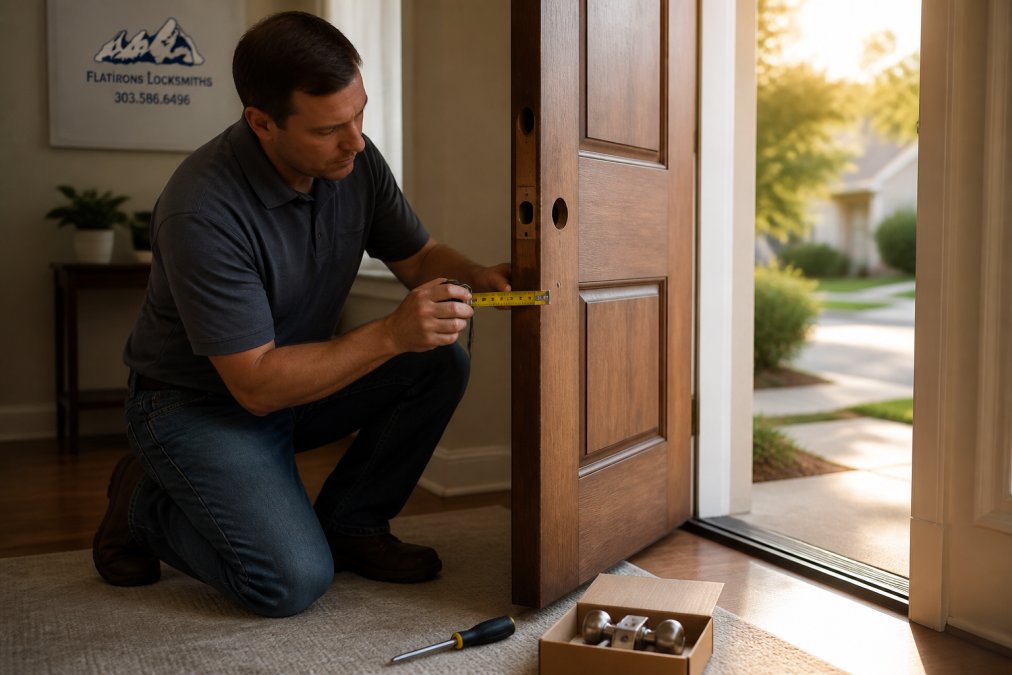
A lock rated for a 1-3/4-inch door won’t seat on a thinner door without a spacer or adapter, so check the spec sheet.
Lock Types and Functions: Deadbolt, Knob, Lever, and More
A deadbolt is a locking mechanism with a solid bolt that extends into the door frame, operated by a key or thumb turn. It’s the foundation of entryway protection, separate from the handle.
| Lock Component | What It Does | Where It’s Used |
|---|---|---|
| Deadbolt | Solid bolt into frame | All exterior doors |
| Knob or lever | Opens the door | Every door |
| Mortise lock | Latch and bolt in one body | Older and heavy doors |
| Handle set | Decorative grip and trim | Front entries |
ANSI/BHMA Lock Grades: What the Ratings Actually Mean
ANSI/BHMA grades are standardized ratings for how much abuse a lock takes before failing. The American National Standards Institute and the Builders Hardware Manufacturers Association set them, the industry’s closest thing to an objective durability score.
ANSI/BHMA standards for architectural hardware
Smart Lock vs Mechanical Lock: Which Fits Your Home?
A mechanical lock uses only a key and internal pins. A smart lock adds electronics on top of that core: keypad codes, keyless entry, Bluetooth or Wi-Fi, often a fingerprint reader. Both can be secure; the right pick depends on how you use the door.
Choose a mechanical lock when:
- You want zero batteries, zero apps, and nothing to fail in a power outage.
- The door is a back door, garage entry, or side gate you rarely use.
- You’re renting and don’t want to manage an account or firmware updates.
Choose a smart lock when:
- You need keyless entry for family, guests, cleaners, or short-term renters.
- You want scheduled or temporary codes that expire automatically.
- You want the lock tied into an alarm, camera, or hub you already run.
A smart lock’s security depends on its mechanical core, not its app. If the underlying deadbolt is Grade 3, no amount of keypad convenience changes that.
What to check before you buy a smart lock
Power source. Most smart locks run on AA alkaline batteries, lasting about six months to a year depending on traffic and radio use. Some offer a rechargeable pack or hardwired option. Confirm there’s an emergency override, usually a physical key or 9-volt jump terminal, so a dead battery doesn’t lock you out.
The honest trade-offs
Smart locks add failure points: batteries, radios, firmware, and an app that may not be supported in five years. They also add convenience, temporary codes, entry logs, auto-lock. With a reputable mechanical body underneath, the trade-off is usually worth it. For a rarely used door, a mechanical deadbolt is simpler and longer-lived.
Pick-Resistance, Bump-Proofing, and Bolt Throw
Pick-resistant and bump-proof features make a lock harder to defeat without the key. A pick-resistant cylinder uses security pins that resist manipulation. Bump-proof locks resist a bump key, which jolts pins into position in seconds on a cheap cylinder. Bolt throw is how far the bolt extends into the frame; a full 1-inch throw gives more to grab than a short one.
A Grade 3 cylinder with no anti-bump pins can be opened with a bump key in seconds. If your exterior locks are builder-grade, that’s the first thing to replace.
How to Rekey a Door Lock or Call a Locksmith
Rekeying changes the internal pins so a new key works and old ones don’t. It’s the standard move for new residents and costs far less than replacing hardware. You can rekey a door lock yourself with a pin kit and follower, or hand it to a locksmith.
- Remove the lock from the door and separate the cylinder.
- Match the new key to the pin stack for each chamber.
- Insert new pins and springs, then reinstall the plug.
- Reassemble the lock and test the key.
- Repeat for every exterior lock so one key fits all.
Maintenance, Insurance, and Emergency Lockout Planning
Most guides stop at the purchase. What decides whether your lock still works in five years is what happens after installation.
A simple maintenance routine
Locks fail from grit, moisture, and loose fasteners far more often than picking. A short annual routine prevents most of it.
- Lubricate the cylinder once a year with a dry graphite or PTFE (Teflon) spray. Never use wet oils like WD-40 or petroleum-based lubricants, they attract dust and gum up the pins over time.
- Tighten the strike plate and hinge screws seasonally. A loose strike plate is the first thing to give under force, and it’s also a common cause of a door that suddenly won’t latch.
- Wipe finish hardware with a soft, dry cloth. Abrasive cleaners strip the finish and can dull a keypad or fingerprint sensor.
- Replace worn keys before they wear the pins. A key with rounded or shiny teeth is grinding down the cylinder every time you use it.
- Test every exterior lock monthly, key, thumb turn, and any keypad code, so you find a problem before you’re standing outside at night.
- On a smart lock, replace batteries on a schedule, not when the low-battery warning fires. Keep a spare set on hand and know where the emergency override key is stored.
If a key starts sticking, don’t force it. Forcing a stiff key is how cylinders get damaged. Lubricate first, and if it still sticks, have the cylinder serviced or replaced.
What your insurance policy may actually require
Many homeowners policies include entry-protection language, and some require exterior doors to carry a deadbolt or a lock of a certain grade to keep coverage intact after a break-in claim. Requirements vary by carrier and state, so read your own policy or call your agent directly.
A few things worth confirming with your carrier:
- Whether a deadbolt is required on every exterior door, or only the primary entry.
- Whether a minimum ANSI/BHMA grade is specified.
- Whether a smart lock with a keypad satisfies the requirement, or whether a mechanical keyed deadbolt is expected.
- Whether any discount applies for upgraded locks, deadbolts, or a monitored alarm.
Consumer guidance on home security and insurance
Planning for a lockout before it happens
An emergency lockout is a bad time to search for a phone number. A little planning removes most of the panic.
- Keep a spare key with a trusted neighbor, not under the mat, in a fake rock, or in a mailbox. Those hiding spots are the first ones a burglar checks.
- Save a locksmith’s number in your phone and in a shared note your household can access.
- On a smart lock, know exactly where the emergency override key lives and test it at least once. A backup key you’ve never used is not a backup.
- Know your lock’s failure modes. A dead battery, a dropped network connection, or a jammed bolt all look different, and the fix is different for each.
- If a high-security lock fails and you can’t get in, a locksmith can often bypass or drill the cylinder and replace it. That’s a service call, not a disaster, but it’s faster if you already have a number saved.
When to repair versus replace
A sticking lock, worn key, or loose strike plate is a repair. A cylinder that’s been picked, bumped, or drilled is a replacement. Mismatched locks, or ones older than the door, are usually worth replacing as a set so one key works everywhere. A locksmith can tell you in minutes whether a rekey and tune-up will do or new hardware is the better spend.
A lock that’s been drilled or forced should always be replaced, not repaired. The internal pins and cylinder are compromised even if the lock still turns.
Frequently Asked Questions
What is the most secure type of door lock for a residential property?
A Grade 1 deadbolt with a 1-inch bolt throw, pick-resistant cylinder, and reinforced strike plate offers the highest residential security. Pair it with a reinforced door frame and consider a smart lock with physical key override. ANSI/BHMA Grade 1 locks withstand the most physical assault testing. For front doors, a single-cylinder deadbolt plus a heavy-duty handle set covers both security and daily use.
What are the differences between Grade 1, 2, and 3 locks?
ANSI/BHMA grades reflect durability and security testing. Grade 1 is the highest, built for heavy commercial use and able to survive hundreds of thousands of cycles and significant physical attack. Grade 2 suits light commercial and high-end residential. Grade 3 is typical builder-grade residential hardware. If you are choosing residential door locks, Grade 1 or 2 deadbolts are worth the upgrade for exterior doors.
Should I choose a deadbolt or a smart lock for my front door?
Both. A smart lock replaces the deadbolt, not the handle set. Choose a smart lock if you want keyless entry, remote access, and activity logs. Choose a mechanical deadbolt if you prefer no batteries or app dependency. Many homeowners install a smart deadbolt with a traditional handle set below. For back doors, a mechanical deadbolt with a keyed cylinder is often simpler and just as secure.
How do I determine the correct backset for my door lock?
Measure from the edge of the door to the center of the hole where the lock cylinder sits. That distance is the backset, typically 2-3/8 inches or 2-3/4 inches in the U.S. Most new locks include an adjustable latch to fit both. Also check door thickness (standard is 1-3/8 to 1-3/4 inches) and the existing bore hole diameter. If you are unsure, a locksmith can measure and confirm fit before installation.