
Table of Contents
- 1. Install a Smart Lock for Keyless Entry
- 2. Upgrade to High Security Locks and Hardware
- 3. Smart Lock Installation: What to Expect
- 4. Spare Key Storage Ideas That Actually Work
- 5. Build a Pre-Departure Routine to Prevent Home Lockouts
- 6. Smart Home Integration and Emergency Access
- 7. Cost-Benefit Analysis of Lockout Prevention Methods
- Conclusion: Take Action to Prevent Home Lockouts
- Frequently Asked Questions
Last Updated: September 16, 2026
1. Install a Smart Lock for Keyless Entry
The single most effective way to prevent home lockouts is to remove the key from the equation entirely. A smart lock replaces your traditional deadbolt with a keypad, key fob, or biometric scanner, so there is no physical key to lose, forget, or leave in a coat pocket at work. For households juggling school runs, shift work, and deliveries, that eliminates the most common cause of a residential lockout before it happens. Better yet, install 2 or 3 of them and remove the possibility of failure from the equation with redundancies so if one of your locks batteries dies or just fails you have another way in.
How Smart Locks Prevent Lockouts
A smart lock is an electronic deadbolt that grants entry through a keypad code, mobile app, fingerprint, or proximity sensor instead of a metal key. Because access is digital, you can unlock your door from a phone even when you are standing on the wrong side of it, and you can issue a temporary code to a neighbor or a service technician in seconds.
The practical options break down by how much you want to change:
|
Lock Type |
Entry Method |
Best For |
Backup Access |
|---|---|---|---|
|
Full smart deadbolt |
Keypad, app, fob |
Replacing old hardware |
Key or code |
|
Retrofit smart lock |
App, auto-unlock |
Renters, keep existing keys |
Original key |
|
Keypad deadbolt |
Code only |
Simple, no WiFi |
Physical key |
|
Biometric lock |
Fingerprint, code |
Fast, hands-free entry |
Code |
What most buyers miss is the backup layer. A keyless system still needs a fallback for a dead battery or a forgotten code, and that is where spare key storage and a trusted contact come in. At Flatirons Locksmiths, we install electronic deadbolts and smart locks for homeowners across the north metro area, and a key consideration is how you plan to get in when the technology fails.
2. Upgrade to High Security Locks and Hardware
High security locks are deadbolts and lock cylinders built with hardened steel, anti-pick pins, and reinforced strike plates that resist drilling, bumping, and forced entry. Upgrading your hardware does more than stop burglars, it also prevents the frustrating mechanical failures that leave a working key spinning uselessly in a worn cylinder.
Older locks wear out.
Look for these features when you shop:
- ANSI/BHMA Grade 1 or Grade 2 rating for residential security
- Solid brass or hardened steel construction, not pot metal
- A reinforced strike plate secured with long screws into the door frame
- A lock cylinder that resists bumping and picking
- A deadbolt with at least a 1-inch throw
When to Call a Professional for Installation
Call a locksmith when your door is misaligned, when the new hardware does not match your existing bore holes, or when you want the strike plate reinforced into the framing. A door that sticks or a deadbolt that binds usually signals a deeper alignment problem that a new lock alone will not fix. Professional installation can help ensure the hardware is properly fitted.
3. Smart Lock Installation: What to Expect
Smart lock installation typically takes 20 to 45 minutes per door for a standard deadbolt replacement, and a professional can confirm your door, frame, and existing bore holes are compatible before any hardware comes out of the box. The job is straightforward on a standard 2-3/8 inch or 2-3/4 inch backset, and more involved on older or non-standard doors.
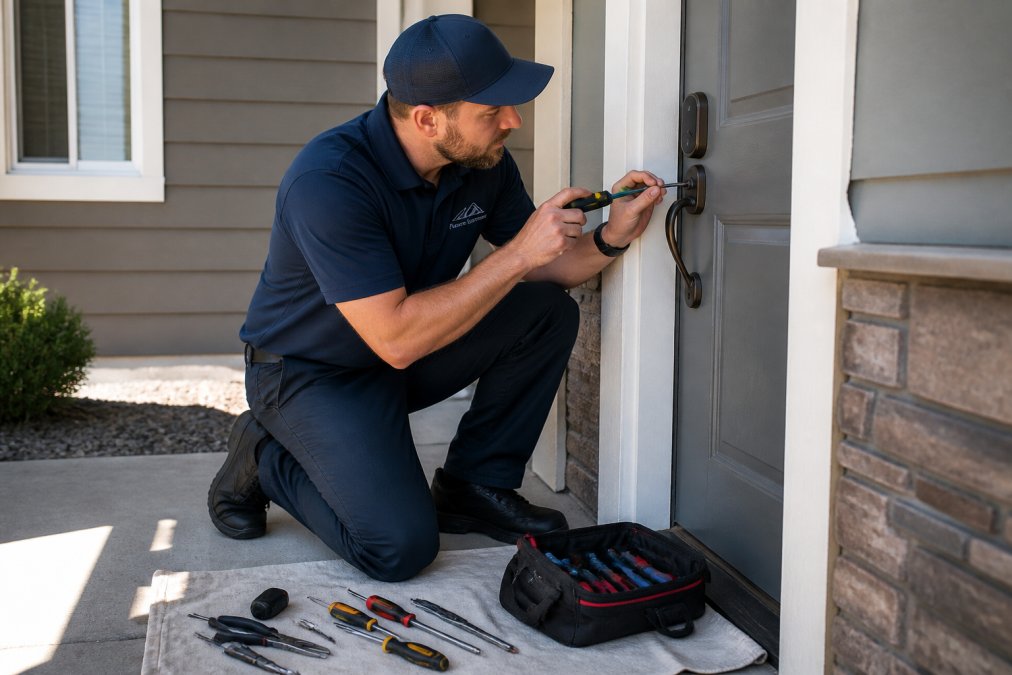
DIY vs. Professional Installation
Do it yourself if you are replacing a deadbolt with the same footprint and your door closes cleanly. Hire a professional if you are switching lock types, adding a keypad where none existed, or your door has ever needed a shove to latch.
4. Spare Key Storage Ideas That Actually Work
The doormat and the fake rock are the first places a burglar looks, so retire both. Real spare key storage means a locked, tamper-resistant container that a trusted person can reach, or a digital copy that cannot be found by a stranger walking your porch.
- Wall-mounted key safe: A heavy-duty metal box bolted to the exterior, opened with a push-button combination. Durable and tamper-resistant, but it requires permanent mounting.
- Portable lockbox: A shackle-mounted box that hangs on a doorknob or fence. Easy to relocate, less secure than a bolted unit.
- Digital key backup: A service that scans and stores a copy of your key in the cloud, so you can order a replacement at a kiosk or by mail instead of calling an emergency locksmith.
- Trusted neighbor: Give a spare to someone you actually trust, and tell no one else where it lives.
5. Build a Pre-Departure Routine to Prevent Home Lockouts
The best ways to prevent home lockouts are behavioral as much as mechanical. Most lockouts happen not because a lock failed but because a person was distracted, rushed, or running on autopilot when they walked out the door. A fixed routine removes the decision from the moment and hands it to habit.
- Keys, phone, wallet. Pat the same pocket in the same order, every time.
- Lock check. Confirm the deadbolt is engaged before the door closes behind you.
- Backup check. Confirm your spare key or digital code is still accessible before you need it.
6. Smart Home Integration and Emergency Access
Smart home integration turns a single smart lock into a coordinated access control system. When your lock talks to your alarm, cameras, and lighting, you can grant entry remotely, see who arrived, and disarm the system in one action, which is exactly what you need when a family member is locked out and you are not home.
The features worth setting up:
- Geofencing: The lock unlocks automatically as your phone approaches, so you never fumble for a code with full hands.
- Temporary guest codes: Issue a code that expires after a set window for a cleaner, dog walker, or delivery.
- Activity log: See a timestamped record of every entry, useful for spotting a code that leaked.
- Voice and app control: Unlock from a phone or smart speaker when you are away.
7. Cost-Benefit Analysis of Lockout Prevention Methods
Prevention almost always costs less than the emergency it avoids, but the methods are not equal. Weigh each option by upfront cost, ongoing effort, and how much it reduces your real risk.
|
Method |
Upfront Cost |
Ongoing Effort |
Lockout Risk Reduction |
|---|---|---|---|
|
Smart lock (keyless entry) |
Moderate to high |
Low (battery checks) |
High |
|
High security lock upgrade |
Moderate |
None |
Moderate |
|
Spare key lockbox |
Low |
Low |
High |
|
Digital key backup |
Low or free |
Low |
Moderate |
|
Pre-departure routine |
None |
Habit only |
High |
|
Trusted neighbor |
None |
None |
High |
Conclusion: Take Action to Prevent Home Lockouts
The gap between a smooth arrival and a 10 p.m. call to a locksmith usually comes down to one unsecured backup. Flatirons Locksmiths has served the north metro area since 2012, and our team handles everything from electronic deadbolt and smart lock installation to rekeying, lock repair, and access control for homes and businesses. We provide mobile service at your location, give you an upfront quote before any work begins, and are a member of the ALOA Security Professionals Association.
Frequently Asked Questions
How hackable are smart locks?
Most modern smart locks use AES 128-bit or 256-bit encryption, making them difficult to hack remotely. The bigger risk is weak user codes or sharing access carelessly. Choose locks from reputable brands, enable two-factor authentication where available, and change default codes immediately after smart lock installation. Physical bypass is rare on quality deadbolts, but professional installation ensures the hardware is properly seated and tamper-resistant.
What are the best places to store a spare key safely?
Avoid predictable spots like under the doormat, above the doorframe, or in a fake rock. Instead, use a wall-mounted key safe or a portable lockbox. Mount it in a discreet location, not visible from the street. Alternatively, leave a spare with a trusted neighbor or use a digital key service to store a copy in the cloud.
What locks do police recommend for doors?
Law enforcement typically recommends ANSI/BHMA Grade 1 or Grade 2 deadbolts with a minimum 1-inch throw bolt. Look for solid brass or hardened steel construction and a reinforced strike plate secured with 3-inch screws. High security locks with anti-pick and anti-bump features add another layer. A locksmith can verify proper installation.
Should I hide a spare key outside my home?
Hiding a key outside is risky because burglars know all the common spots. If you must keep an outdoor spare, use a combination lockbox rather than a hidden key. Mount it securely in a location not visible from the street, and change the combination periodically. Better yet, consider a smart lock with a keypad or biometric scanner so you never need a physical spare at all.
What should I do if I am frequently losing my house keys?
First, establish a consistent place to store keys the moment you enter, such as a hook by the door or a tray on a console table. Use a bright keychain or lanyard to make keys easier to spot. If losing keys continues, switch to a keyless entry system. A digital backup can also help you replace lost keys quickly without a locksmith visit.