
Table of Contents
- Step 1: Check Licensing, Insurance, and Professional Credentials
- Step 2: Read Reviews and Verify Customer Testimonials
- Step 3: Get Locksmith Price Estimates Before You Commit
- Step 4: Understand Emergency Locksmith Availability
- Step 5: Identify Common Locksmith Scams to Avoid
- Step 6: Confirm Post-Service Verification and Invoicing
- Step 7: Choose a Local, Mobile Locksmith with a Clear Service Radius
- Frequently Asked Questions
Last Updated: September 19, 2026
Step 1: Check Licensing, Insurance, and Professional Credentials
Learning how to find reliable locksmiths starts with one non-negotiable check: credentials. A legitimate locksmith carries state or local licensing where required, In Colorado it is not required so the next best thing is ALOA Membership or membership to local locksmith associations. A legitimate locksmith holds liability insurance, and often maintains bonding through a surety. Check to make sure
What a Valid Locksmith License Looks Like
A valid license or membership lists the holder’s legal name, license number, expiration date, and issuing authority. You can also cross-check that number against the state or county database or membership organization rather than trusting the card alone. Membership organizations often have a list of their members online.
Why Bonding and Insurance Matter
Bonding protects you financially if a technician commits theft or fraud, while liability insurance covers accidental damage to your door, frame, or lock hardware. A company that cannot produce a certificate of insurance is passing that risk to you.
Step 2: Read Reviews and Verify Customer Testimonials
Reviews are the fastest credibility filter, but only when read critically. Look for specific, dated accounts that name the technician and describe the work performed. “Robin rekeyed our locks in 30 minutes” tells you more than fifty generic five-star ratings. Also, don’t just check one review source, Google is rife with stuffed reviews, if a business has been around for 5 to 10 years and has 2,000 reviews on Google I would look around at other sources. Check their Yelp listing or the Better Business Bureau.
Spotting Fake or Paid Reviews
Fake reviews cluster. Watch for a burst of five-star ratings posted within days of each other, identical phrasing across accounts, or reviewers with no other history. Cross-reference ratings on more than one platform and check whether the business responds to criticism with specifics.
Step 3: Get Locksmith Price Estimates Before You Commit
A fair locksmith price estimate is itemized, given before work begins, and confirmed in writing. Ask for the service call fee, labor rate, and parts separately. If a dispatcher will only quote “starting at” a low figure without breaking it down, treat that as a warning.
What a Fair Quote Includes
A complete estimate names the service call fee, per-lock labor charge, hardware costs, and any after-hours surcharge. Reputable providers confirm the total quoted over the phone when they get on-site before starting, so the invoice matches the quote.
Fair-Price Ranges for Common Services
Most guides stop at “get a quote.” The more useful move is knowing roughly what a job should cost before you call, so an inflated number is obvious. The ranges below reflect typical residential pricing in most metropolitan markets and vary with region, time of day, and lock type. Treat them as sanity checks, not fixed rates.
The Lowball-Then-Surge Pattern
The most common predatory pricing tactic is a deliberately low phone quote followed by an on-site increase. The dispatcher quotes below market to win the call, the technician arrives, claims the lock is more complex than described, and presents a total several times higher. Because you are locked out and the technician is already there, the pressure to pay is enormous.
Defenses that work:
- Get the quote in writing or by text before the technician is dispatched, including the after-hours surcharge.
- Ask the dispatcher to confirm the total will not change unless you approve additional work.
- If the on-site price jumps, you are allowed to decline. Ask the technician to leave and call another provider. You may owe a service call fee, but you are not obligated to authorize work at a price you never agreed to.
- Pay by card when possible. Cash-only demands remove your ability to dispute the charge.
|
Quote Element |
What to Confirm |
Red Flag If… |
|---|---|---|
|
Service call fee |
Flat fee stated upfront |
Fee revealed only on arrival |
|
Labor rate |
Per-lock or hourly |
Rate changes mid-job |
|
Parts and hardware |
Itemized by lock |
Bundled into a vague total |
|
After-hours surcharge |
Stated before dispatch |
Added without warning |
|
Total price |
Confirmed in writing or text |
Only given verbally, changes on-site |
Step 4: Understand Emergency Locksmith Availability
Emergency locksmith availability means a mobile technician is dispatched to your location as soon as they are available. Unfortunately they are not like emergency services that are provided by your city fire, ambulance and police departments and are not waiting around for you to call. Most locksmiths stay pretty busy and just because their location is in your area does not always mean that they are at the shop but could be on a job. If they tell you this then don’t be dismayed because they are giving you the truth of it upfront, if someone tells you that they are 5 to 15 minutes away be prepared to wait and hour to an hour and half because they are not being truthful in most cases unless they can give you their exact location (It does happen that sometimes we are just down the road) The key word is “mobile.” so they could be anywhere but if they give you a realistic time frame then you know you are in good hands. Also, a time is an estimate, the dispatcher does not always know at what point in the job the locksmith he is dispatching is at, he may have just gotten started, been delayed, finishing up so if he says he is about half an hours away from you it may be possible that you have to add some time for finishing the job they are on currently.
Questions to Ask Before an Emergency
Ask these before you need them, not during a crisis:
- What is your average emergency response time?
- Is the technician dispatched local or routed from another region?
- Will I get a firm quote before the technician starts?
- Do you carry the hardware needed for my lock type on the truck?
Step 5: Identify Common Locksmith Scams to Avoid
Common locksmith scams to avoid follow a predictable script. A call center quotes an unrealistically low price, dispatches an unmarked vehicle, then claims your lock is “unpickable” and drills it out, charging several times the quoted amount. The technician may also demand cash and refuse an itemized invoice.
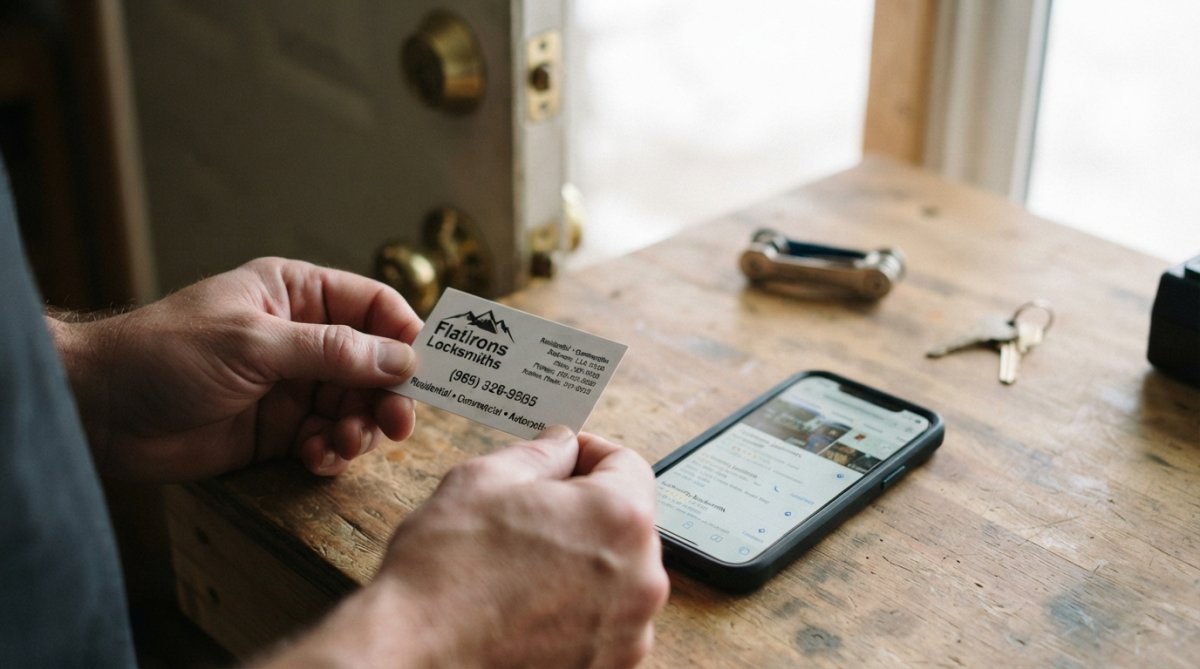
The absolute best way to spot a scam is to ask the following question of the dispatcher who answers the phone:
Where are you located?
Don’t ask if they are in your town, they can easily say yes to that question but ask them where they are located and where the locksmith will be coming from? If they try to avoid the question or get angry you can either reiterate the question or just hang up.
This way you take charge, and if they have no idea where they are or where you are calling from without you telling them then they are not local and you should avoid them at all costs.
The Full Scam Playbook
Recognizing the pattern early is what protects you. Common tactics include:
- The lowball phone quote. A price far below market is bait. It exists to get a technician to your door, where the real number appears.
- The “unpickable lock” claim. Most residential locks can be opened non-destructively by a competent technician. A claim that drilling is the only option is often a way to justify a much higher charge and sell you a replacement lock.
- The unmarked vehicle and no local address. A technician who cannot name a physical local business address, drives an unbranded vehicle, and wears no identification is a warning sign.
- Cash-only demands and no invoice. Refusing to provide itemized paperwork removes your ability to dispute the charge and is a hallmark of fraudulent operators.
- Pressure and urgency. Being told you must decide immediately, or that the price will rise if you wait, is a manipulation tactic, not a service policy.
- Subcontracted dispatch. A national-sounding call center that routes your job to whoever is available means the person at your door may have no relationship to the company you called.
How to Report a Scam
Most guides mention scams but stop short of telling you what to do. Reporting matters: it protects the next customer, creates a paper trail if you dispute the charge, and feeds the pattern data regulators use to act.
Before you report, document everything:
- The company name, phone number, and any website or listing you found them through.
- The technician’s name or description, and the vehicle make, model, and any plate number.
- The original quote (text, email, or a screenshot of the listing) and the final invoice.
- Photos of the work performed, the lock, and any damage.
- Payment records: card statement, receipt, or a note if cash was demanded.
Where to report:
- Your state attorney general’s consumer protection division. This is the primary office for consumer fraud complaints in most states, and many accept complaints online.
- The Federal Trade Commission (FTC) at ReportFraud.ftc.gov. The FTC collects complaints and shares them with law enforcement partners; it does not resolve individual disputes but its database is used to build cases.
- Your state or local licensing board. If the locksmith claimed a license, report the misrepresentation to the issuing authority.
- Your card issuer. If you paid by credit card, you may be able to dispute the charge for services not rendered as agreed.
- The Better Business Bureau. Not a government agency, but a complaint there creates a public record that other consumers will see.
Post-Service Verification: What to Check Before the Technician Leaves
Verification is the step most people skip, and it is where problems get caught while you still have leverage. Before the technician drives away:
- Test every lock yourself. Turn the key, operate the deadbolt, and confirm the door closes without binding. Do not accept “it just needs to settle.”
- Check for damage. Look at the door, frame, and strike plate for scratches, gouges, or forced marks that were not there before.
- Confirm the count. If you paid to rekey three locks, verify all three were actually rekeyed and that your old key no longer works.
- Get the itemized invoice. It should list each service, part, and fee, and match the quote you approved.
- Follow up over the next few days. A properly rekeyed lock should operate smoothly, and a new deadbolt should align with the strike plate. If something fails, contact the company in writing immediately.
Step 6: Confirm Post-Service Verification and Invoicing
Post-service verification confirms the job was done correctly and priced fairly. Before the technician leaves, test every lock yourself: turn the key, operate the deadbolt, and check that the door closes without binding.
Step 7: Choose a Local, Mobile Locksmith with a Clear Service Radius
A local, mobile locksmith with a defined service radius arrives faster and answers to a community rather than a national call center. Ask where the business is based and how far it travels. A clear service radius tells you whether the technician is genuinely nearby or routing from hours away.
Local vs. National Chains
Local providers live with their reputation. They depend on repeat business and referrals from neighbors, which aligns their incentives with doing the job right. National call centers often subcontract to whoever is available, so pricing and quality vary wildly between calls.
Frequently Asked Questions
How do I know if a locksmith is reputable?
Check for a physical local address, a valid state license, and membership in a professional association like ALOA. Look for verified customer reviews on multiple platforms and ask for an itemized quote before work begins. A reputable locksmith will provide a clear on-site estimate and won’t pressure you into unnecessary services. Flatirons Locksmiths, for example, is ALOA member #64049 and has been locally owned since 2012.
What questions should I ask a locksmith before they arrive?
Ask where they are located, if they can’t or won’t answer then they are not local and you should avoid them. Ask for proof of insurance, and a total price estimate including any service call fee. Confirm their expected arrival time and whether they charge by the job or by the hour. Also ask if they will provide an itemized invoice after the work. These questions help you avoid common locksmith scams to avoid and ensure you’re hiring a trusted professional.
How much does an emergency locksmith typically charge?
Emergency locksmith pricing varies by location, time of day, and the type of lockout. There is no single average because rates depend on the service radius, after-hours fees, and hardware involved. Request a locksmith price estimate upfront and get it in writing. Flatirons Locksmiths provides upfront quotes before work begins, so you know the cost before they start.
Are there red flags to look for in locksmith advertising?
Yes. Be wary of unmarked vehicles, no physical address, prices that seem too low to be true, and pressure to pay in cash only. Also watch for operators who arrive without identification or refuse to provide an itemized invoice. These are common signs of locksmith scams to avoid. Always verify credentials and read third-party reviews before hiring.
Finding a locksmith you can trust comes down to verification: confirm the license, check the insurance, read reviews critically, and insist on a written quote before anyone starts work. Flatirons Locksmiths makes that easy with upfront quotes, mobile service to your location, emergency and scheduled availability, and a team that has served the area since 2012. Get started with Flatirons Locksmiths and schedule an appointment with a verified local professional.