
Table of Contents
- Why Move Beyond Traditional Keys?
- Core Benefits of Commercial Access Control Systems
- The Power of Cloud-Based Access Control for Business
- PDK Access Control Benefits for Daily Operations
- Why Expert Commercial Door Hardware Installation Matters
- Calculating the Total Cost of Ownership
- Conclusion: Secure Your Business with the Right System
- Frequently Asked Questions
Last Updated: September 8, 2026
Commercial access control systems are no longer a luxury reserved for corporate campuses; they are a practical necessity for any business that takes physical security seriously. The benefits of commercial access control systems extend far beyond simply locking a door, touching on operational efficiency, compliance, and even your bottom line. In this guide from Flatirons Locksmiths, we break down how modern systems work and why upgrading from traditional keys or even an out of date legacy access control system is one of the smartest security investments you can make this year.
Most facility managers still rely on metal keys, a habit that creates hidden liabilities. Every lost key means a costly rekey, and you have no record of who entered the building or when. Cloud-based access control eliminates these problems by replacing the physical key with credentials that you can manage instantly from a dashboard.
Why Move Beyond Traditional Keys?
The biggest risk with traditional keys isn’t theft; it’s the lack of visibility. When an employee leaves on bad terms, that key still opens your door unless you pay to rekey the entire facility. This reactive approach to security leaves gaps that can cost thousands in lost inventory or damaged assets.
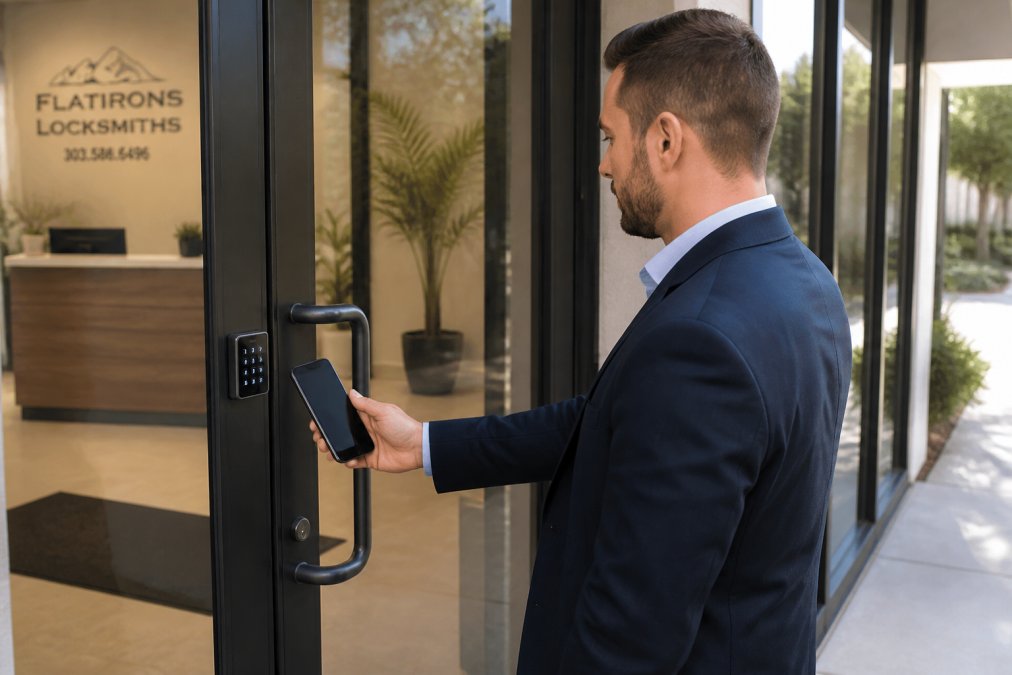
Mechanical keys also offer zero accountability. If a server room is accessed at 2 a.m., you have no way to know who was there. Modern electronic access control replaces guesswork with a precise digital record, giving you a complete audit trail of every entry and every employee. This shift from “who has the key” to “who has permission” is the foundational change that drives most of the benefits discussed below.
Core Benefits of Commercial Access Control Systems
Commercial access control is the practice of managing who can enter specific areas of your business using electronic credentials rather than traditional mechanical keys. While the headline advantages fall into security, efficiency, and compliance, the real value emerges when you examine the specific mechanisms and integrations that separate a modern system from a simple digital lock.
Enhanced Security and Asset Protection
The primary benefit is the ability to restrict access down to the individual user and specific time windows. You can grant a contractor access to the warehouse only during business hours on weekdays, while your management team retains 24/7 access. This granularity is impossible with physical keys.
Modern systems support multi-factor authentication and biometric authentication, adding layers of verification beyond a simple card or fob. If a credential is lost or stolen, you can deactivate it remotely in seconds, eliminating the window of vulnerability that exists with a lost key. This centralized management ensures your security infrastructure adapts instantly to personnel changes.
Operational Efficiency and Time Savings
Manual key management is a drain on administrative time. Tracking who has which key, collecting them from departing staff, and scheduling rekeys are tasks that disappear with an electronic system. Instead, you manage user permissions from a web-based dashboard.
Keyless entry also means no more lockouts. Employees use mobile credentials on their smartphones or smart cards to enter, so there is no physical key to lose or forget. For facilities with multiple doors, this convenience translates directly into smoother start-of-day workflows and less downtime waiting for someone to unlock a door.
The Integration Advantage: Beyond Security to HR and Payroll
A benefit most security-focused guides miss is the ability to integrate your access control system with your HR and payroll software. When an access control event is tied to a specific employee ID, that same event can be used to automate time and attendance tracking. This eliminates the need for separate punch clocks or manual timesheet entry, reducing payroll errors and administrative overhead.
For example, when an employee uses their mobile credential to enter the building, that timestamp can automatically sync with platforms like BambooHR, Gusto, or ADP. This creates a single source of truth for both physical presence and payroll calculation. The practical outcome is that your security system becomes a piece of operational infrastructure, not just a safety measure. This workflow is particularly valuable for businesses with hourly workers, shift-based schedules, or remote teams that need to verify on-site hours.
Audit Trails and Compliance Reporting
Every access event is logged automatically, creating a detailed access log that shows who entered, which door they used, and the exact timestamp. This data is invaluable for internal investigations and for meeting compliance reporting requirements in regulated industries.
If you handle sensitive data, inventory, or operate under industry standards like HIPAA or SOX, these automated records provide the documentation auditors require (hhs.gov). Instead of digging through sign-in sheets, you generate a compliance report with a few clicks, demonstrating that your security protocols are enforced consistently.
|
Benefit Category |
What It Solves |
Operational Impact |
|---|---|---|
|
Enhanced Security |
Lost keys, unauthorized entry |
Instant credential revocation |
|
Operational Efficiency |
Admin time on key management |
Self-service user permissions |
|
HR & Payroll Integration |
Manual time tracking |
Automated attendance syncing |
|
Audit Trails |
No entry records |
Automated access logs |
|
System Integration |
Siloed security hardware |
Centralized management |
The Power of Cloud-Based Access Control for Business
Cloud-based access control for business is the modern standard because it moves management off a local server and into a secure, web-based platform. This architecture supports real-time monitoring from any device, meaning you can check who is on site or unlock a door for a delivery from your phone.
The operational advantages are significant. Remote management allows you to grant temporary access to visitors without being physically present, simplifying your visitor management system. Furthermore, these platforms are designed for scalability; adding a new user or a new door takes minutes, not days.
PDK Access Control Benefits for Daily Operations
For businesses seeking a system that balances advanced features with ease of use, PDK’s access control benefits are substantial. PDK, or Pro Data Key, offers a cloud-managed platform known for its intuitive interface, allowing your team to self-manage the system without specialized IT training.
The real advantage of PDK lies in its system integration capabilities. It connects seamlessly with many systems such as intercom, visitor management, video surveillance, intrusion detection and much more to help you manage you business more efficiently than ever and creating a unified security and compliance ecosystem. These integrations mean your access control events can trigger video surveillance cameras to track on who is in the building and their whereabouts at any given time. This automated decision-making between systems reduces manual work and strengthens your overall security posture.
Why Expert Commercial Door Hardware Installation Matters
The software is only half the equation. A high-tech access control system is only as reliable as the physical door hardware it controls. Commercial door hardware installation requires precision; if the strike plate is misaligned or the closer is set incorrectly, the electronic lock will fail to secure the door properly, creating a vandalism prevention weakness and a safety hazard. Flatirons Locksmiths is versed in all aspects of commercial entryways and the installation of all the access control hardware that is required to operate a system like this, no contractors to deal with when installing our systems, we do it all.
A locksmith with deep physical hardware knowledge understands the mechanics of doors, frames, and exit devices. They ensure that the electronic components work in harmony with the mechanical ones, providing workplace safety and reliable operation. This is where the “best of both worlds” matters most: you need a partner who understands the cloud software and the physical electronic locks on the door.
Calculating the Total Cost of Ownership
Looking beyond the initial installation quote is essential. A Total Cost of Ownership (TCO) analysis reveals that electronic systems often deliver long-term savings compared to mechanical ones. While the upfront cost is higher, you eliminate the recurring expenses of rekeying locks after every employee departure.
To make an apples-to-apples comparison, break the TCO into three distinct buckets: hardware, subscription, and maintenance.
Hardware Costs
This includes the physical door hardware (electronic locks, readers, controllers) and the credentials (cards, fobs, or mobile licenses). For a facility with 10 doors and 50 employees, a typical hardware package includes:
- 5 to10 electronic locks or readers – the core hardware at each entry point.
- 2-3 network controllers – these connect the door hardware to your network and the cloud platform.
- Power supplies and cabling – necessary for electric strikes or magnetic locks.
- Credential media – either physical smart cards or mobile credential licenses for each employee.
A common pattern is that hardware represents the largest one-time capital expense. However, unlike mechanical locks that need to be replaced entirely when rekeying, electronic hardware is reusable. When an employee leaves, you simply delete their credential, you don’t replace the lock.
Subscription and Software Costs
Cloud-based access control platforms like PDK, Alarm.com, and Brivo operate on a per-door monthly subscription model. This fee covers the software license, cloud hosting, automatic updates, and technical support. It also includes the cybersecurity maintenance, encryption updates and vulnerability patches, that keep your system protected against digital threats.
This subscription model is often a point of hesitation for budget-conscious managers. However, it replaces the unpredictable, reactive costs of mechanical key management. Instead of paying $150-$300 per lock for an emergency rekey after a key is lost, you pay a predictable monthly fee that covers unlimited credential changes (homeadvisor.com). It also replaces the high upfront cost of a server based system and the IT maintenance that comes with that. Many legacy systems haven’t been maintained in years and therefore fall into disrepair, the longevity of these cloud based systems has been increased substantially by the constant updates pushed to it to keep it functioning and up to date at all times.
Maintenance and Administrative Costs
This is where the savings compound. Consider the following:
- Reduced Hardware Maintenance: Fewer physical key replacements and lock changes. Electronic locks have fewer moving parts than mechanical cylinders, meaning less wear and tear.
- Lower Administrative Costs: Time saved on key tracking and management. If an office manager spends 2 hours per week managing keys, that’s over 100 hours per year of lost productivity.
- Eliminated Rekeying: The average cost to rekey a single commercial lock is between $75 and $150, plus labor (angi.com). If you rekey just 5 locks per year due to lost keys or employee turnover, that’s a recurring expense that disappears entirely.
- Potential Insurance Savings: Many insurers recognize the reduced risk of advanced security systems, which can positively influence premiums. This is a point worth raising with your provider.
The 5-Year TCO Perspective
A useful way to frame the decision is to project costs over a 5-year period. While the initial year of an electronic system will be higher due to hardware and installation, the total cost over 5 years often converges with, or beats, the cost of a mechanical system when you factor in rekeying, administrative overhead, and the cost of a single security incident.
The real financial risk is not the subscription fee; it’s the cost of a breach or theft that a mechanical key system cannot prevent or trace. While specific savings vary, the operational efficiency gains and the reduction in security incidents typically justify the investment. For a detailed quote tailored to your facility, contacting a professional for a site assessment is the best first step.
Conclusion: Secure Your Business with the Right System
Upgrading to a commercial access control system is a decision that pays dividends in security, efficiency, and peace of mind. The shift from mechanical keys to cloud-managed credentials addresses the core vulnerabilities of modern facilities, from unauthorized access to a lack of accountability.
At Flatirons Locksmiths, we bring the best of both worlds: deep expertise in physical door hardware and advanced knowledge of state-of-the-art cloud-managed access control. We offer and install leading systems like PDK, Alarm.com, and Brivo, ensuring you get a solution that is highly secure and easy for your team to manage. We provide upfront quotes and mobile service, helping you secure your property without the headaches. Schedule an appointment with us to explore the right system for your business.
Frequently Asked Questions
What are the primary security benefits of cloud-managed access control?
Cloud-managed access control provides real-time monitoring and instant alerts, so you know who enters your facility at all times. It eliminates the risk of lost or copied keys by using unique mobile credentials or key cards. Features like data encryption and user permissions protect against unauthorized access. You can also instantly revoke access for former employees or contractors, closing security gaps that exist with traditional keys. This centralized approach strengthens your overall physical security posture.
What is the difference between traditional key-based systems and modern cloud access control?
Traditional key systems offer no audit trail, require physical key management, and often need rekeying after an employee leaves. Modern cloud access control uses electronic locks managed through an online dashboard. It provides a detailed audit trail of every entry, allows you to grant or revoke access remotely, and eliminates the need to rekey. This shift offers centralized management, better security, and significant operational efficiency for businesses of all sizes.
How do PDK, Brivo, and Alarm.com systems enhance business operations?
PDK, Brivo, and Alarm.com are state-of-the-art cloud-based systems that centralize your security management. They allow you to manage user credentials, monitor access logs, and control doors from a simple interface. These systems integrate with other security tools like video surveillance, enabling a unified response to alerts. Their scalability means you can easily add new users or doors as your business grows. The user-friendly dashboards make self-management simple, reducing your reliance on manual processes.
Can I manage my commercial security system remotely?
Yes, cloud-based commercial access control systems are designed for remote management. You can access the system from any internet-connected device to grant or revoke access, view real-time activity, and receive instant alerts on your phone. This capability is essential for business owners who travel or manage multiple locations. It provides peace of mind and ensures you can respond to security events immediately, no matter where you are.
How does a locksmith-integrated approach improve access control installation?
A locksmith-integrated approach ensures that the physical security hardware and the digital access control system work perfectly together. Locksmiths have deep knowledge of door mechanics, framing, and commercial-grade hardware. They can properly install electronic locks and ensure they align correctly for reliable, long-term operation. This expertise prevents installation errors that can lead to failures, security vulnerabilities, or voided warranties. It provides a single point of accountability for the entire security ecosystem.