
Last Updated: October 29, 2026
Quick Summary
Colorado gun storage rules focus on keeping firearms away from minors and prohibited persons, so the test is whether someone who should not handle the gun could reach it easily. A home defense firearm should sit in a hard-sided locked container that only authorized adults can open, placed where an adult can reach it quickly.
- Storage is judged by whether a minor or prohibited person could reach the firearm.
- A soft case, zippered pouch, or cable lock alone does not count as a hard-sided locked container.
- Biometric pistol safes open very fast for enrolled adults and resist child access well.
- Vehicle storage also needs theft resistance, so the container should be cabled or bolted down.
- Confirm current penalties and insurance conditions through Colorado legal resources or an attorney.
Table of Contents
- Colorado Gun Storage Laws: The Core Requirements
- Storing a Home Defense Firearm Safely Inside Your Home
- How to Secure a Home Defense Weapon Without Losing Access
- Best Gun Safes for Home Defense: Types and What to Look For
- Households With Children and Multiple Residents
- Penalties for Unsafe Firearm Storage in Colorado
- Storing Firearms in Vehicles and Insurance Considerations
- Setting Up Your Home Storage Plan With Flatirons Locksmiths
- Frequently Asked Questions
Colorado Gun Storage Laws: The Core Requirements
Colorado’s storage rules center on preventing access by people who should not handle a firearm, especially children. The statute is less about a single locking device and more about whether the firearm was stored responsibly given who lives in or visits the home.
What the statute means by responsible and secure storage
Responsible and secure storage generally means the firearm is not accessible to a minor or a prohibited person without the owner’s supervision or consent. Think of the test as access control: could someone who should not touch the gun reach it easily? If yes, the storage is probably not compliant, regardless of how carefully you intended to store it. Review the current statute text through the Colorado General Assembly statutes before relying on any summary, including this one.
Who the law is designed to protect
The primary concern is unsupervised juveniles and other people barred from possessing firearms. Colorado’s approach places responsibility on the owner, which is why the consequences focus on the adult who controlled the gun. A household with children, a frequent visitor under 18, or a resident with a prohibited history all change what “secure” has to mean in practice.
Storing a Home Defense Firearm Safely Inside Your Home
A home defense firearm has to be fast to reach and still out of reach of anyone else. Those two goals pull against each other, and most storage mistakes happen when someone solves only one of them.
Keeping a loaded firearm for home defense
Keeping a loaded firearm for home defense may be lawful depending on your circumstances, and the way it is stored matters. Verify how the current statute treats loaded storage for your specific situation, because the rules have changed over time.
Balancing quick access with protection from unauthorized access
It helps to decide in advance who in the house needs to open the storage point and how quickly. Biometric, keypad, and mechanical combination devices each trade off speed, child resistance, and reliability. Watch out: a fast-opening device that a teenager can figure out in a minute is not secure storage, no matter how quickly the owner can use it.
How to Secure a Home Defense Weapon Without Losing Access
The practical goal is a storage setup you can open under pressure in the dark, yet that a child or visitor cannot open at all. Start by listing every person who lives in or regularly visits the home, then pick a device that passes the strictest test on that list.
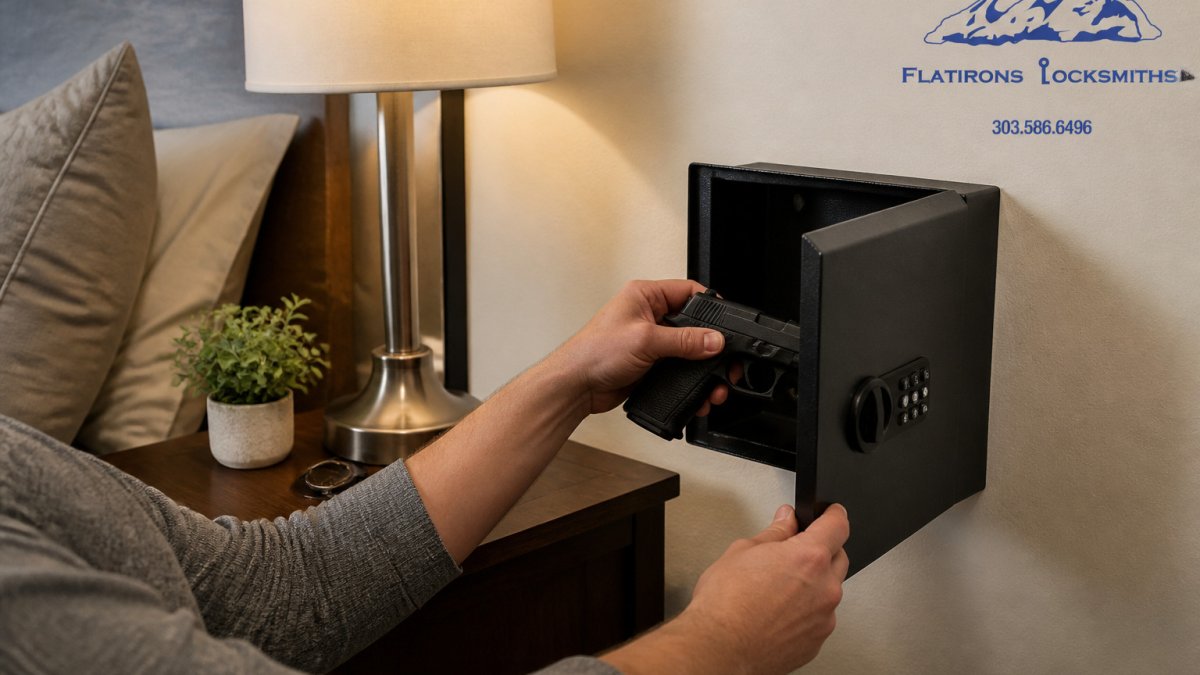
Here is a simple process to follow:
- Confirm which residents are minors or prohibited persons, and who else enters the home regularly.
- Choose a locked hard-sided container or safe with a locking mechanism that only authorized adults can operate.
- Mount or place the device where you can reach it without turning on lights or walking across the room.
- Test the opening sequence in the dark, with the same hand and the same stress you would have in an emergency.
- Recheck the setup whenever the household changes, such as a new child, a live-in relative, or a houseguest pattern.
For a smart lock versus traditional deadbolt comparison relevant to securing a storage point, see our breakdown of smart lock security tradeoffs and how each option handles tamper resistance. Our team at Flatirons Locksmiths can also install and rekey a storage point so only authorized adults hold the access method, which is a common fix for the access-control concern above.
Best Gun Safes for Home Defense: Types and What to Look For
Not every safe suits home defense, so the type matters as much as the brand. The four categories below cover most homes, and the right choice depends on access speed, the number of firearms, and whether children are present.
| Storage Type | Access Speed | Child Resistance | Best For |
|---|---|---|---|
| Wall-mounted lockbox | Fast | Moderate | One handgun near a bed |
| Biometric pistol safe | Very fast | High | Adults needing instant access |
| Keypad safe | Fast | High | Households with multiple adults |
| Full-size gun safe | Slower | Very high | Long-term storage of several firearms |
What counts as a hard-sided locked container
A hard-sided container is a rigid enclosure that keeps its shape under pressure and cannot be peeled, torn, or collapsed by hand. In practice that means a steel or heavy polymer box, a safe, or a lockbox with a solid body and a locking lid or door. A soft gun case, a zippered pouch, a drawer with a trigger lock, or a cabinet with a glass door generally does not meet the hard-sided test because the container itself can be defeated without opening the lock. When you shop, look for a body and door made of steel or a comparable rigid material, a locking mechanism that engages the door or lid directly, and no exposed hinges or pry points that a child or casual visitor could exploit.
What counts as an approved locking mechanism
The statute does not publish a single approved lock list, so the practical test is whether the lock actually prevents unauthorized opening. A keyed lock, a mechanical combination dial, a keypad, and a biometric reader can all qualify if they are built into or attached to the hard-sided container and cannot be bypassed by lifting the lid, prying the door, or removing the container from its mount. A cable lock threaded through the trigger guard is not a container lock and does not turn a soft case into a hard-sided locked container. Avoid any device with a backup key override that sits in an obvious place, and avoid locks that a child can defeat with a paperclip, a magnet, or a firm pull.
Matching the device to the threat in your home
A wall-mounted lockbox is fast and keeps one handgun off a nightstand, but its child resistance is only moderate because the mount and the lock body are the weak points.
When you evaluate a UL safe rating standard or similar independent test rating, look for the listed fire and burglary protection classes rather than marketing claims. Flatirons Locksmiths is an authorized dealer for Hollon Safe Company. Pricing varies with the model and features, so contact us for a quote after learning what you need.
Households With Children and Multiple Residents
Households with children, teenagers, or several adults need a plan that accounts for everyone. A gun safe that works perfectly for one adult can fail when a second adult or a visiting teenager learns the code. Assign access to specific adults only, and change codes or keys when someone leaves the household. Keep the access method, whether a key, code, or fob, separate from the firearm itself.
Penalties for Unsafe Firearm Storage in Colorado
Unsafe storage can bring criminal and civil consequences, and the specifics depend on the facts of the case, including whether a minor gained access and whether harm followed. Many homeowners are surprised that liability can attach even when the owner did not intend any harm. Because penalty levels and classifications are set by statute, confirm the current details through Colorado state legal resources or consult a licensed attorney rather than relying on a general summary.
Storing Firearms in Vehicles and Insurance Considerations
Vehicle storage follows different rules than home storage, and a firearm left in a car creates its own risks around theft and unlawful access. The core requirement is that the firearm be kept in a locked, hard-sided container and out of plain view, and you should check the current statute for any additional conditions that apply to your situation. A glove box or center console is not a hard-sided locked container for this purpose, and a soft case on the back seat is the classic violation. A steel lockbox cabled to the seat frame, a console vault, or a trunk-mounted safe is the practical fix, and you should test that the container cannot be removed with the cable or mount intact.
Vehicle storage versus home storage
Home storage is judged by whether a minor or prohibited person can reach the gun inside the home. Vehicle storage adds a theft dimension: the container must resist removal as well as opening, because a thief who can carry the whole box away defeats the lock. That is why a cabled lockbox or a bolted vault is stronger than a loose pistol case, and why you should never leave the container in plain view through the window. If you must leave a firearm in a vehicle for any length of time, lock the container, lock the vehicle, and park where the container is not visible.
How storage compliance affects insurance and liability
Insurance is worth a direct conversation with your carrier. Some homeowners policies include conditions or exclusions tied to secure storage, and a claim can be harder to resolve if the firearm was accessible in a way the policy did not anticipate. Ask your insurer two questions in writing: whether a theft claim involving a firearm requires proof of locked storage, and whether a rider or endorsement is needed to cover firearms above the standard personal property limit.
Because penalty levels, classifications, and insurance conditions change, confirm the current figures through Colorado state legal resources or consult a licensed attorney and your insurer rather than relying on a general summary.
Setting Up Your Home Storage Plan With Flatirons Locksmiths
Putting these rules into practice usually comes down to a few decisions: which device fits your household, where it should be mounted, and who gets access. Flatirons Locksmiths has served north metro Denver since 2012 with mobile service at your location, and we provide upfront quotes before any work begins. If you’re ready to set up a storage plan that meets your needs, schedule an appointment with our team and we will walk through the options for your home.
Frequently Asked Questions
Can you store a gun at home in Colorado?
Yes. Colorado allows you to keep firearms at home, but state law expects them to be stored responsibly and securely. The statute focuses on preventing access by unsupervised juveniles and prohibited persons. Owners who keep a loaded firearm for home defense should use a locked, hard-sided container or equivalent storage device that keeps the weapon inaccessible to people who should not handle it. Review the current statutory text or consult a licensed attorney for how the rules apply to your household.
Does Colorado law require a gun safe for home defense weapons?
Colorado’s safe storage provisions require secure storage, and a locked, hard-sided container is the approach the statute describes as meeting that standard. A gun safe is one option, but the law does not require a specific brand or model. A lockbox, quick-access container, or other locked storage device can also work if it prevents unauthorized access. Confirm the exact requirements with the current statute before deciding.
What are the penalties for failing to secure a firearm in Colorado?
Penalties depend on the circumstances. Under Colorado law, leaving a firearm accessible to a minor or prohibited person can carry criminal and civil consequences, depending on the facts. Consequences can apply if a child gains access and injures someone. Penalty details change with the facts, so review the statute and speak with a qualified attorney if you face a charge.
Can I keep a loaded firearm for home defense in Colorado?
Whether a loaded firearm may be kept at home depends on the current statute and your circumstances, and storage rules still apply when the home includes children or other people who are not allowed to access firearms. A loaded weapon should be kept in a manner that prevents unauthorized access while remaining quickly accessible to the owner. Balancing those two goals is the core of responsible home storage.
