
Table of Contents
- Why Locks Become Sticky: The Root Causes
- Signs of a Failing Door Lock You Should Not Ignore
- Tools and Supplies You Will Need for the Fix
- Step-by-Step: How to Fix a Sticky Lock
- The Best Lubricant for Door Locks (and What to Avoid)
- How to Lubricate a Deadbolt the Right Way
- Smart Lock Maintenance: What Is Different
- When to Call a Professional Locksmith
- Frequently Asked Questions
Last Updated: September 12, 2026
Why Locks Become Sticky: The Root Causes
Sticky locks are almost never a sign that the lock itself is failing. In most cases, the mechanism is telling you something is interfering with the internal components, and the fix is simpler than replacing the hardware. At Flatirons Locksmiths, we handle sticky lock calls, and the pattern is predictable: something is either gumming up the works or the door has shifted just enough to bind the bolt.
Understanding why locks get sticky fix starts with separating the two main culprits. One is contamination inside the cylinder. The other is mechanical or structural wear. They feel similar at the key, but they require completely different solutions.
Dirt, Grime, and Debris Buildup
Every time you insert your key, you push microscopic debris deeper into the lock body. Dust, pocket lint, airborne particles, and even skin oils accumulate on the pins and springs over months and years. Over time, this buildup creates friction that makes the key drag or catch.
Outdoor locks face this faster than interior ones. Wind carries grit into the keyway, and rain can wash dirt into the cylinder where it dries and hardens. If your lock sits on an exterior door, expect contamination to be the primary suspect.
Mechanical Wear and Internal Corrosion
Inside every pin tumbler lock, small springs push pins into the keyway. After thousands of key insertions, those springs weaken and the pins develop flat spots. The cylinder walls wear down too, creating rough surfaces that grab the key.
Moisture accelerates this process. Corrosion on the internal mechanism, particularly in humid climates or on doors exposed to weather, roughens the metal surfaces. A lock that once turned smoothly starts to feel gritty because the components are literally deteriorating. This is when rekeying or replacement becomes the smarter path.
Signs of a Failing Door Lock You Should Not Ignore
Catching a failing lock early saves you from being locked out at the worst possible moment. The warning signs are usually obvious once you know what to look for. The key is to act on them before the lock fails completely.
Watch for these indicators:
- The key requires jiggling or force to turn
- You feel grinding or catching inside the cylinder
- The key only works when you pull the door toward you
- The deadbolt extends but does not fully seat
- Visible rust or discoloration around the cylinder face
- The key sticks when you try to remove it
Any one of these signals means the lock needs attention. Two or more together usually means the problem is advancing quickly.
Misalignment and Door Frame Issues
A door that has shifted on its hinges throws the lock and strike plate out of alignment. The deadbolt or latch hits the edge of the strike plate instead of sliding cleanly into the hole. This creates binding that feels exactly like a sticky lock, but no amount of lubricant will fix it. Another cause of misalignment is the soil in Colorado has a lot of expansive bentonite clay, this causes the soil under your to shift usually due to changes in climate. The soil expands and contracts with the heat, cold, heavy rain & snow melt along with freeze-thaw cycles placing massive pressure on your foundation.
Check for misalignment by opening the door and inspecting the strike plate. If you see scrape marks or fresh gouges on the metal, the bolt is hitting the plate rather than passing through it. Seasonal swelling in wooden doors and foundation settling both cause this, and it tends to worsen over time.
Environmental Factors That Affect Lock Performance
Temperature swings, humidity, and salt air all affect how a lock performs. Metal expands and contracts with temperature changes. Wooden doors swell in summer humidity and shrink in dry winter air. Both movements change how the lock and strike plate line up.
In cold weather, residual moisture inside a lock can freeze and block the pins (extension.psu.edu). In coastal or humid environments, corrosion sets in faster than most homeowners expect. If your lock acts up only in certain seasons, environmental factors are likely the cause. Another cause of misalignment specifically in Colorado is a lot of expansive bentonite clay in the soil, this causes the soil under your home to shift usually due to changes in climate. The soil expands and contracts with the heat, cold, heavy rain & snow melt along with freeze-thaw cycles placing massive pressure on your foundation.
Tools and Supplies You Will Need for the Fix
Gathering the right tools before you start keeps the job quick and prevents damage. Most of what you need is already in a basic household toolkit.
- Compressed air can or a small bellows blower
- Non-metallic pick or toothpick
- Small soft-bristle brush
- Lock lubricant (dry or silicone-based)
- Clean rag or microfiber cloth
- Screwdriver set for strike plate adjustment
- Flashlight for inspecting the keyway
Do not use cotton swabs inside the keyway. The fibers catch on the pins and make the problem worse.
Step-by-Step: How to Fix a Sticky Lock
The right repair sequence matters. Cleaning before lubricating prevents you from sealing debris inside the mechanism. Follow these steps in order for the best result.
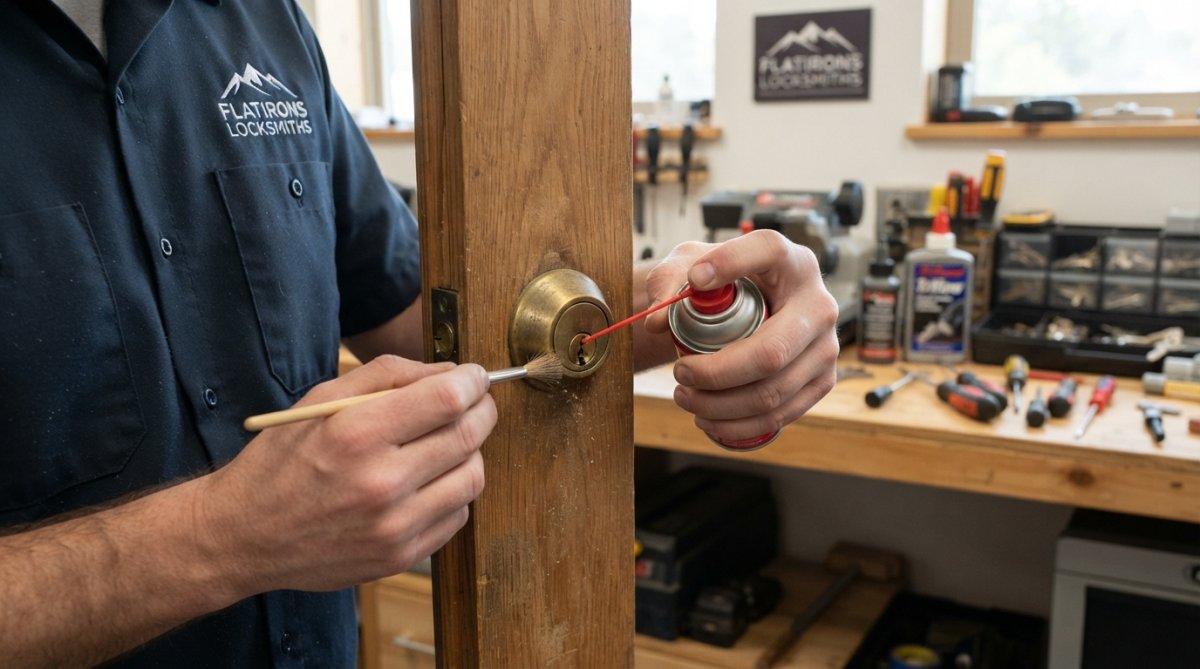
Step 1: Diagnose the Problem
Try the key with the door both open and closed. If the lock turns freely when the door is open but binds when closed, the issue is alignment, not contamination. If it sticks in both positions, the cylinder needs cleaning or lubrication.
Step 2: Clean the Keyway and Cylinder
Spray compressed air into the keyway in short bursts to blow out loose debris. Insert a non-metallic pick to gently dislodge packed grime, then blow again. Work the key in and out several times to loosen anything caught on the pins, and wipe the key clean after each pass.
Step 3: Apply the Right Lubricant
Apply a small amount of dry lubricant or silicone spray directly into the keyway. Insert and turn the key several times to distribute it through the cylinder. Wipe away any excess that comes out. One application is usually enough, and more is not better.
The Best Lubricant for Door Locks (and What to Avoid)
The best lubricant for door locks is a dry lubricant, specifically graphite powder or a PTFE-based spray (diy.stackexchange.com). These products leave a thin, dry film that reduces friction without collecting dust. They work in both interior and exterior locks and hold up through temperature changes. But “dry lubricant” is not a single product, and picking the wrong one for your lock type or climate can leave you worse off than before. Use the compatibility chart below to match the product to the job.
|
Lubricant Type |
Best For |
Works In Cold |
Attracts Dust |
Notes |
|---|---|---|---|---|
|
Graphite powder |
Interior knob and deadbolt cylinders |
Yes |
Low |
Can clump in high humidity; messy on keys and pockets |
|
PTFE (polytetrafluoroethylene) spray |
Exterior locks, all climates, smart lock keyways |
Yes |
Very low |
Carrier must fully evaporate; apply in short bursts |
|
Silicone spray |
Occasional maintenance on low-use locks |
Yes |
Moderate |
Over-application creates a tacky film that grabs grit |
|
Lithium grease |
Nothing in a residential lock |
Thickens |
High |
Traps debris; use only on exposed hinges and strike plates |
|
WD-40 or penetrating oil |
Nothing in a lock cylinder |
Yes |
High |
Leaves a residue that gums pins and springs over time |
|
Cooking oil or general-purpose grease |
Nothing in a lock |
Thickens |
High |
Turns into a paste that requires disassembly to remove |
How to Choose Based on Your Situation
- Interior lock, no prior oil use: Graphite powder is the simplest option. Puff a small amount into the keyway, cycle the key, and wipe the key clean.
- Exterior lock exposed to rain or humidity: PTFE spray is the better choice because it resists moisture and does not wash out as quickly as graphite.
- Coastal or salt-air environment: PTFE spray, applied more frequently. Salt accelerates corrosion on the cylinder face and pins, so reapply every few months rather than once a year.
- Lock previously treated with oil or grease: Do not add dry lubricant on top. The new product will mix with the old residue and create a gummy paste. Clean the cylinder first with a dedicated lock cleaner or non-chlorinated brake cleaner applied sparingly, let it fully evaporate, then apply dry lubricant.
- Smart lock keyway: PTFE spray only, and only in the mechanical keyway. Never spray near the motor housing, battery compartment, or circuit board.
What to Avoid and Why
The products in the “avoid” rows share one trait: they leave a wet or tacky film. That film captures dust, lint, and metal shavings, and over months it hardens into a paste that binds the pins. A lock treated with the wrong lubricant often needs to be removed, disassembled, and cleaned in a solvent bath before it will work smoothly again. In some cases the residue damages the springs enough that replacement is the cheaper path.
A Note on Quantity
More lubricant is not better. A one-second burst of PTFE spray or a light puff of graphite is enough for a residential cylinder. Excess product migrates to the springs and pin chambers, where it collects debris and eventually causes the same sticking you were trying to fix.
How to Lubricate a Deadbolt the Right Way
A deadbolt has a different mechanism than a knob or lever lock, so the lubrication process is slightly different. The bolt extends into the door frame rather than retracting into the door itself, which means you need to lubricate both the cylinder and the bolt mechanism.
Start by removing the interior thumb-turn if your deadbolt allows it. This exposes the internal components. Apply dry lubricant to the bolt mechanism, then work the thumb-turn back and forth to spread it. Reassemble the lock and test the action several times.
For the cylinder side, apply lubricant into the keyway and cycle the key. If the deadbolt still binds, check the strike plate alignment before adding more lubricant. Nine times out of ten, a deadbolt that sticks after lubrication has an alignment problem.
Smart Lock Maintenance: What Is Different
Smart locks have electronic components that most homeowners overlook during maintenance. The mechanical keyway still needs the same care as a traditional lock, but the motor, sensors, and battery contacts require separate attention.
Clean battery contacts with a dry cloth when you replace batteries (energy.gov). Dust on the contacts causes intermittent power issues that look like lock failures. Do not spray lubricant near the electronic housing, since it can damage circuit boards. Stick to dry lubricant in the keyway only.
Firmware updates matter too. Manufacturers release updates that fix motor timing issues and improve responsiveness. If your smart lock starts acting sluggish, check for an update before assuming the hardware is failing.
When to Call a Professional Locksmith
Some sticky locks are beyond a can of compressed air and a dry lubricant. Call a professional when the key breaks off inside the cylinder, when the lock has been treated with the wrong lubricant and needs internal cleaning, or when the door frame itself has shifted enough that the strike plate needs repositioning.
Flatirons Locksmiths has served the north metro area since 2012, handling everything from sticky deadbolts to full lock replacement and rekeying. As a member of the ALOA Security Professionals Association and an authorized dealer for Emtek Lock Hardware, the team brings the right tools and parts to every job. Pricing is quoted upfront before any work begins, so there are no surprises.
Frequently Asked Questions
How do you fix a sticky lock?
Start by diagnosing whether the issue is dirt or misalignment. Clean the keyway with compressed air and a soft brush, then apply a dry lubricant like graphite powder or PTFE spray. Insert and turn the key several times to distribute it. If the key still binds, check the strike plate and hinges for alignment problems. For persistent sticky locks, a professional can rekey or replace the cylinder.
Does WD-40 help with sticky locks?
WD-40 is not recommended for lock cylinders. It is a solvent-based product that can dissolve the original lubricant inside the lock and attract dust, which creates a gummy residue over time. That residue causes pins and springs to stick worse than before. Use a dry lubricant designed for locks, such as graphite powder or a PTFE-based spray, instead.
What is the best lubricant for a sticky lock?
Graphite powder and PTFE (polytetrafluoroethylene) sprays are the top choices for sticky locks. Graphite works well in dry environments and does not attract dust. PTFE sprays go on wet but dry to a thin film that repels grime. Silicone spray is a good option for outdoor locks exposed to moisture. Avoid oil-based products like WD-40 or petroleum jelly, which collect debris and gum up the internal mechanism.
Can a sticky lock be repaired or does it need replacement?
Most sticky locks can be repaired with cleaning and proper lubrication. If the lock has worn pins, broken springs, or a cracked cylinder housing, replacement is the better option. A locksmith can inspect the internal mechanism and tell you whether a simple rekey or a full replacement is needed. Ignoring signs of a failing door lock, such as a key that jams or spins freely, often leads to a bigger repair later.