
Table of Contents
- Why Professional Alarm Installation Beats a DIY Setup
- Deterrence and Detection: How Professional Alarm Installation Reduces Break-Ins
- Faster Emergency Response and 24/7 Professional Monitoring
- Insurance Discounts for Professionally Installed Alarms
- DIY vs Professional Home Security Installation: What the Research Shows
- Home Security System Maintenance Tips to Keep Your Investment Working
- Smart Home Integration, Cybersecurity, and Long-Term Value
- Conclusion
- Frequently Asked Questions
Last Updated: September 13, 2026
Why Professional Alarm Installation Beats a DIY Setup
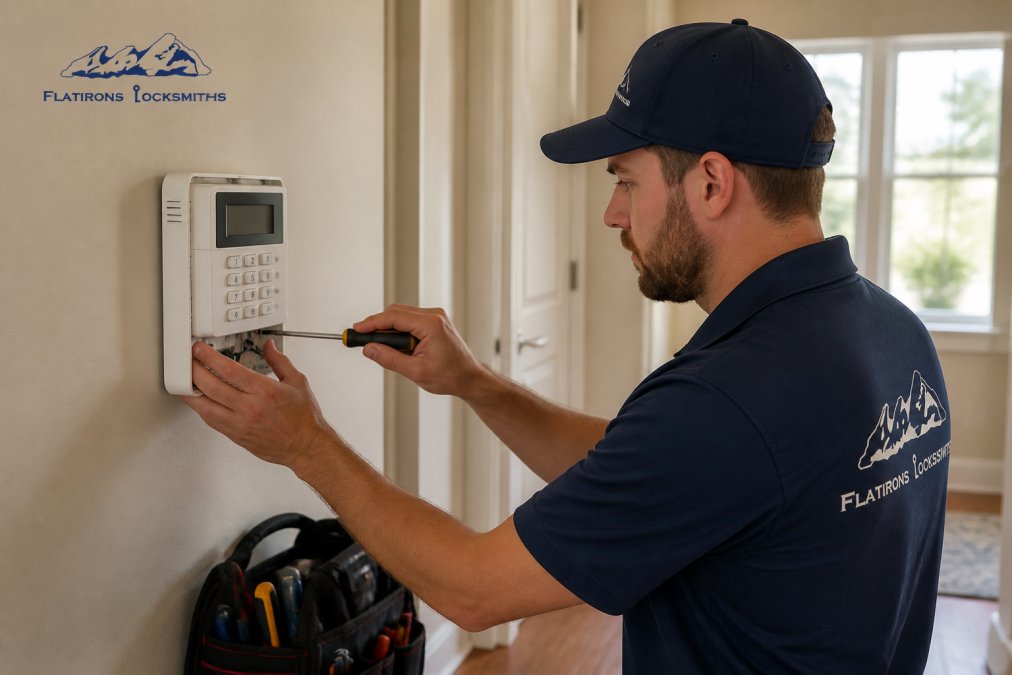
Professional alarm installation is the practice of having a licensed technician design, mount, wire, and calibrate a security system on site rather than assembling it yourself from a box. The core difference isn’t the hardware, it’s the placement, testing, and accountability that come with trained hands doing the work. At Flatirons Locksmiths, we’ve handled residential and commercial alarm work across the north metro area since 2012, and the pattern is consistent: systems installed by professionals perform better on day one and hold up longer.
The most common mistake we see with DIY setups is mounting sensors where the box says to put them, not where the room actually needs coverage.
The Real Cost of Getting It Wrong
A poorly placed motion detector misses the one hallway that matters. A door contact mounted with too much gap triggers on wind. These aren’t cosmetic problems. They’re the difference between a system that protects your property and one you eventually stop arming because it cries wolf.
Professional installation typically includes a walk-through of your layout, a vulnerability assessment of entry points, and calibration testing of every device before the technician leaves. That process is what separates a working system from a box of parts.
Deterrence and Detection: How Professional Alarm Installation Reduces Break-Ins
Burglary deterrence starts with visibility. A professionally installed system puts sensors, cameras, and signage where intruders actually look: front doors, ground-floor windows, and back entries that are easy to reach unseen. According to FBI crime data on burglary, a large share of residential burglaries happen during the day when homes are empty, which makes visible, well-placed equipment a meaningful deterrent.
Strategic Sensor Placement and Motion Detector Calibration
Motion detectors are the most frequently mishandled component in home security. A technician calibrates sensitivity so pets don’t trigger alarms and heat vents don’t register as movement, while still covering the full path from entry to living space. Properly configured sensors ensure that environmental hazards are detected with the same precision as motion, a principle that remains equally vital when integrating smart smoke alarms into your comprehensive security ecosystem.
Fire, Smoke, and Carbon Monoxide Detection That Actually Works
Smoke and carbon monoxide detectors need to be tied into the same monitored system, not left as standalone units. Integration means a triggered alarm reaches a monitoring center even when nobody is home. The U.S. Fire Administration on smoke alarm effectiveness notes that working smoke alarms substantially reduce the risk of dying in a home fire, which is why placement and interconnection matter as much as the device itself.
Faster Emergency Response and 24/7 Professional Monitoring
Emergency response speed depends almost entirely on whether a human is watching the system when it triggers. A professionally monitored system sends an alert to a monitoring center the moment a sensor trips, and that center dispatches police, fire, or medical services without waiting for you to notice a phone notification.
False Alarm Reduction and Cellular Backup Reliability
False alarms are the number one reason people stop using their systems. Professional setup reduces them through proper sensor calibration and zone configuration. Cellular backup keeps the system online when a landline or internet connection drops, which matters because cutting a phone line is a known tactic in residential burglaries.
|
Problem |
What causes it |
How professional setup fixes it |
|---|---|---|
|
Repeated false alarms |
Poor motion detector calibration |
Sensitivity tuned to room size and pet weight |
|
Missed entries |
Sensors placed by guesswork |
Vulnerability assessment of all entry points |
|
System offline during outage |
No backup connection |
Cellular backup module installed and tested |
|
Dead zones |
Coverage gaps in layout |
Full walk-test before handoff |
Insurance Discounts for Professionally Installed Alarms
Many homeowner insurance carriers offer a premium discount for a professionally installed and monitored alarm system, though the exact amount varies by insurer, policy, and state. The discount exists because insurers price risk, and a monitored system with verified professional installation lowers the odds of a costly claim.
What Carriers Actually Ask For
Discounts are not automatic. Most carriers want three things before they apply a credit:
- Central station monitoring, not just a local siren. A system that only makes noise inside the house does not reduce the insurer’s exposure.
- Proof of professional installation, usually a signed certificate or itemized invoice showing the installer’s license number and the date of the walk-test.
- A current monitoring contract or bill, so the carrier can confirm the system is still live at renewal.
A common pattern is a credit applied as a percentage of the annual premium rather than a flat dollar amount, which means the savings scale with how much you already pay. Ask your agent whether the discount is a percentage or a fixed credit, and whether it survives a claim.
The Liability and Warranty Angle Most Guides Skip
Professional installation changes who is responsible when something fails. If a DIY-mounted sensor falls off the wall or a self-drilled hole shorts a wire, the equipment warranty may be voided and the damage is on you. When a licensed technician installs the system, the work itself is typically covered, and the installer carries liability insurance for mistakes made on site.
That distinction matters after a break-in. An insurer investigating a claim will look at whether the system was installed and maintained to the manufacturer’s specification. A professional installation record, a walk-test log, and a maintenance history are the documents that support a claim rather than complicate it. Keep them with your policy paperwork.
Because rates and discount percentages differ so widely by carrier and state, we don’t quote figures here; check with your insurer directly and confirm the credit appears on your next renewal notice.
DIY vs Professional Home Security Installation: What the Research Shows
The DIY versus professional home security installation decision comes down to three trade-offs: upfront cost, time, and how much you trust your own calibration. Most guides stop there. The more useful question is what each path actually costs over five years.
A Five-Year Cost-Benefit Framework
Instead of comparing sticker prices, build the comparison on four lines:
- Hardware and installation, the DIY kit price versus the professional install quote.
- Monitoring, the monthly central station fee, multiplied by 60 months.
- Maintenance and replacement, batteries, failed sensors, panel firmware, and any service calls.
- Insurance offset, the annual premium credit a monitored, professionally installed system may earn, subtracted from the total.
A common pattern is that DIY wins on line one and loses ground on lines two through four. Self-installed systems are more likely to be under-monitored, under-maintained, and ineligible for the installation-based insurance credit, which quietly erases the upfront savings. Run the math with your own quotes rather than a generic table, the crossover point depends on your monitoring rate and your carrier’s discount.
The Hidden Costs of Misconfiguration
DIY systems cost less upfront and give you full control. What most guides miss is the cost of getting it wrong: sensors that trigger falsely, coverage gaps you never notice, and no professional to call when something stops working. A system you stop arming because it cries wolf protects nothing, and that is a total loss on the hardware, not a partial one.
Professional installation costs more initially but typically includes testing, warranty support, and a technician who has seen hundreds of layouts. A common mistake is buying a DIY kit, mounting everything in an afternoon, and assuming it works. Without a walk test, you have no idea whether the system actually detects an intruder at the far end of your hallway.
Where the Money Actually Goes
If your goal is the lowest possible first invoice, DIY is the honest answer. If your goal is the lowest cost per year of reliable protection, the calculation usually favors professional installation once monitoring, maintenance, and the insurance credit are included. Decide which number you are optimizing before you compare quotes.
Home Security System Maintenance Tips to Keep Your Investment Working
Home security system maintenance tips start with one habit: test every sensor on a schedule. Batteries in wireless contacts and motion detectors drain quietly, and a dead sensor is a silent gap in coverage.
- Test door and window contacts monthly by opening each one and confirming the panel registers it
- Replace batteries annually, or sooner if the panel reports low power
- Clean motion detector lenses with a dry cloth; dust and cobwebs cause false triggers
- Walk-test the full perimeter every six months, especially after moving furniture
- Confirm your monitoring connection is live by calling the monitoring center
System maintenance is also where a local technician earns their keep. If your alarm keeps going off for no reason, the fix is usually recalibration or a failing sensor, not a full replacement. Flatirons Locksmiths handles system calibration, false alarm reduction, and hardware replacement on existing systems.
Smart Home Integration, Cybersecurity, and Long-Term Value
Smart home integration is where professional alarm installation pays off over the long run. Modern panels connect to smart locks, cameras, and mobile apps, giving you remote monitoring and real-time notifications from anywhere. But integration also expands your attack surface.
The cybersecurity question is legitimate. A smart lock or connected panel is only as secure as its network, the National Institute for Standards and Technology has some studies that can lend a lot of insight in this matter NIST. Professionals set up encrypted connections, change default installer codes, and separate your security devices from guest Wi-Fi. The CISA guidance on securing smart home devices recommends changing default credentials and keeping firmware updated, two steps most DIY installers skip entirely.
On long-term value: a professionally installed system typically lasts longer, needs fewer replacements, and holds resale appeal. The upfront premium is real, but so is the difference in how the system performs five years in.
Conclusion
Alarm systems only protect you when they’re installed correctly, tested thoroughly, and maintained on a schedule. Flatirons Locksmiths provides professional alarm installation, system calibration, and maintenance for homes and businesses across the north metro area, with upfront quotes before any work begins and mobile service at your location. If you’re weighing a DIY kit against professional setup, or your existing system needs recalibration, schedule an appointment with Flatirons Locksmiths and get a system you can actually trust.
Frequently Asked Questions
Is it worth paying for professional alarm installation?
Professional alarm installation costs more upfront than a DIY kit, but the difference shows in reliability and response. Certified technicians place motion detectors and sensors where they actually catch unauthorized entry, calibrate the system to reduce false alarms, and confirm cellular backup works before leaving. That setup quality is what makes 24/7 monitoring meaningful. A system that triggers nuisance alerts or misses a door gets ignored by homeowners and monitoring centers alike.
What are the risks of improper alarm system installation?
Improper installation creates blind spots, missed zones, and frequent false alarms. Sensors mounted at the wrong height or angle can fail to detect motion, while poorly wired connections cause intermittent faults. False alarms lead to monitoring fatigue and, in some areas, municipal fines for repeated dispatches. DIY installers also risk voiding equipment warranties and may not configure cellular backup correctly, leaving the system dependent on a single internet connection.
Does professional installation affect home insurance premiums?
Many insurers offer discounts for professionally installed and monitored alarm systems, especially those with central station monitoring and fire detection. The exact discount depends on your provider and policy, so ask your agent what documentation they need, such as a certificate of installation or monitoring contract. A professionally installed system with verified monitoring is easier to document than a self-installed kit, which can simplify the claims process if a break-in occurs.
Can I install a security system myself, or should I hire a pro?
DIY systems work for renters or simple apartments where a few door sensors and a camera cover the main entry points. For larger homes, multi-entry properties, or any system that includes fire and carbon monoxide detection, professional installation pays off. Pros handle control panel wiring, sensor calibration, smart home integration, and cellular backup setup in one visit. Flatirons Locksmiths provides upfront quotes before work begins, so you know the cost before committing.